Tulum didn’t run out of tourists. It gave them no reasons to stay
Miloš Pelucha · Thu Oct 29 2026
An airline can remove a destination from the shortlist as easily as it added it. I learned that in March, when Ryanair stopped flying to the Azores and São Miguel lost six routes overnight.
Tulum is learning the same lesson at a much bigger scale, and in the opposite order. It built the airport first, and then it expected the reasons to come back to follow.
How Tulum got famous
For most of the last century, Tulum was a fishing village next to a Maya ruin on a cliff. In 1960, the village had as few as 92 residents.
Highway 307, a major tourist corridor in Quintana Roo, reached it in the 1970s.
Cancún, a tourism hotspot, was built from scratch to the north, and by the late 1990s Tulum had become the quiet end of the Riviera Maya. The hotel zone had sand-floor cabañas, no grid electricity, yoga, and most of the visitors were backpackers.
It was the anti-Cancún.
Then, new segments started to discover Tulum.
The fashion and wellness crowd found it in the 2000s, which meant the boutique hotels followed.
By 2018, this small, coastal town had around 2.5 million visitors a year. But it took the pandemic to truly take it into a different league.
Mexico kept its borders open to air travellers through 2020; pair that with a working flexibility globally and you know the outcome.
Suddenly, Tulum found itself filled with remote workers, festival crowds, content creators, retreat organisers and founders who came for a month and stayed for six. Developers sold condos off-plan to investors who planned to rent them to that crowd.
All of those visitors arrived the same way: a flight into Cancún, then about two hours and 125 km down the highway.
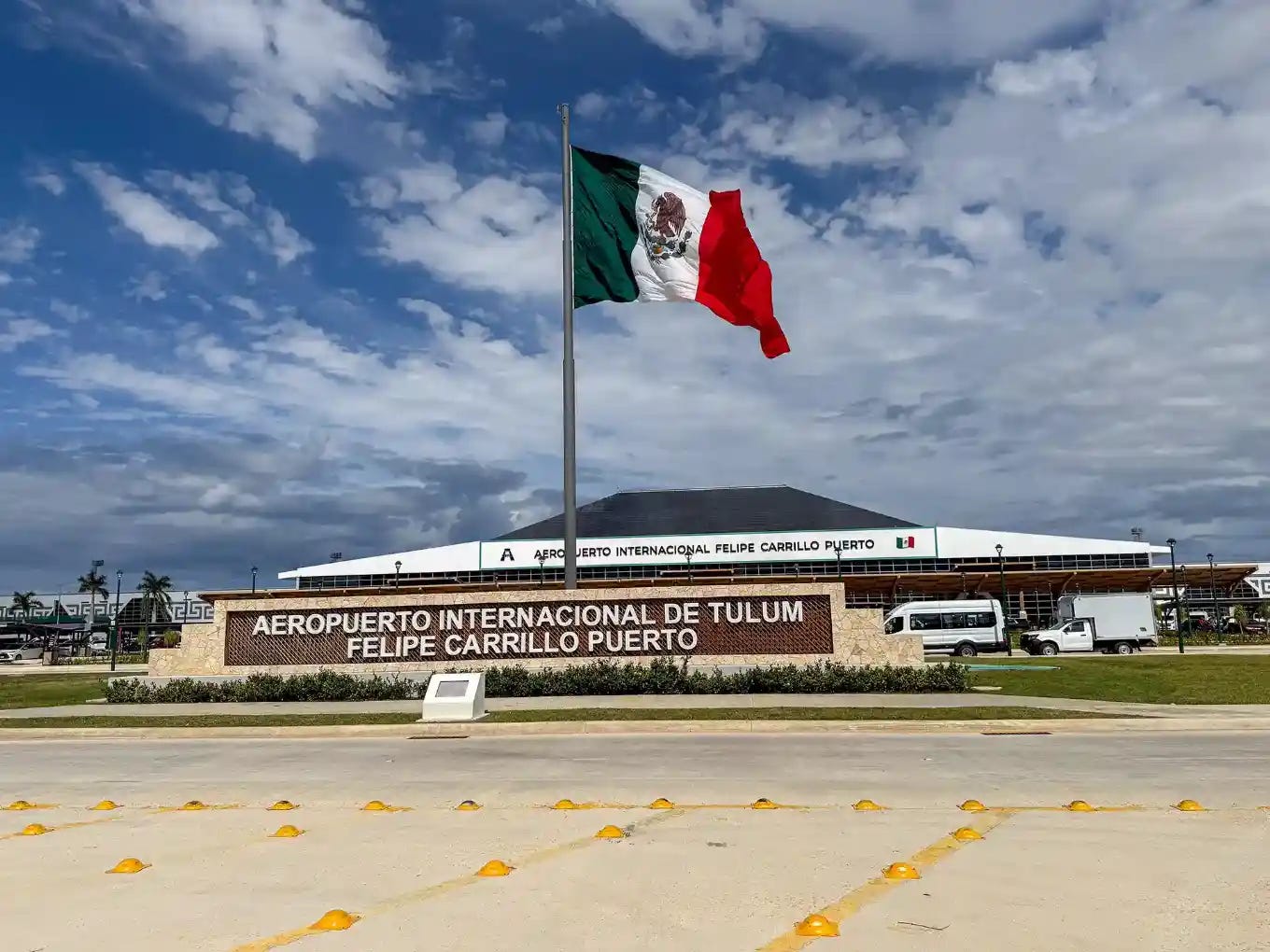
The federal government wanted a second gateway to the coast, so the army built one about 20 km outside Tulum, linked it to the new Tren Maya, and opened it in December 2023. It was designed for 5.5 million passengers a year.
2026, Tulum appears to be in a downward spiral. So what has gone wrong?
Dynamic pricing or greed?
Hotel occupancy averaged 63.69% from January to July this year, down from 72.67% a year earlier. By September, the local hotel association said beachfront hotels were below 20%.
Skyrocketing nightly rates were one part of the story. But visitors - new arrivals as well as returnees had more things to complain about. For most of the boom, a visitor had one way to get anywhere: a taxi.
Pair that with no meter and no published fare. Tulum Times put a ride to the beach zone at 500 pesos or more, about $25. When ride-hailing threatened that, the taxi union blocked the highway.
Uber only launched in Tulum on October 20th, 2026.
Yes, you read that correctly, just less than 2 weeks ago. After the airlines had already started leaving.
The prices didn’t stop at the transportation. F&B was next. Visitors posted 400-peso hamburgers, about $22, or often complained that if an establishment had no prices attached to their menus - only to be inspected later. It’s a case where business owners of the destination realized the buying power of the visitors. But they went incredibly aggressive at it.
Another piece was housing and accommodation. AirDNA data put Tulum’s average Airbnb rate 27% above Playa del Carmen’s - same Riviera, same coast.
But the pricing wasn’t the only thing in Tulum that got out of hand.
The beaches in Mexico are public by law, except for…Tulum
Mexican law says beaches are public and access to them can’t be restricted. That applies to both residents and visitors. Both local and foreign.
In Tulum, getting to the nice beaches increasingly meant paying someone. Jaguar National Park, which holds the ruins and some of the best-known beaches, has been run by a military-owned company since December 2024 and now charges foreigners 415 pesos to enter. Along the hotel zone, fences, guards and minimum spends did the rest.
When visitors fell away last autumn, the town announced free beach access, with no food, drinks or umbrellas allowed. In November, the federal government opened two new public paths to the sea in the hotel zone, and it made national news, which tells you how few there were.
Many hotels would “privatize” beaches and ask for extra payments to enter the most scenic ones. This has been illegal since the beginning,g and it continued being a thing. It went as far as President Claudia Sheinbaum enforcing federal policies confirming that beaches belong to the public and must remain completely accessible without barriers or private restrictions
The part outside anyone’s control
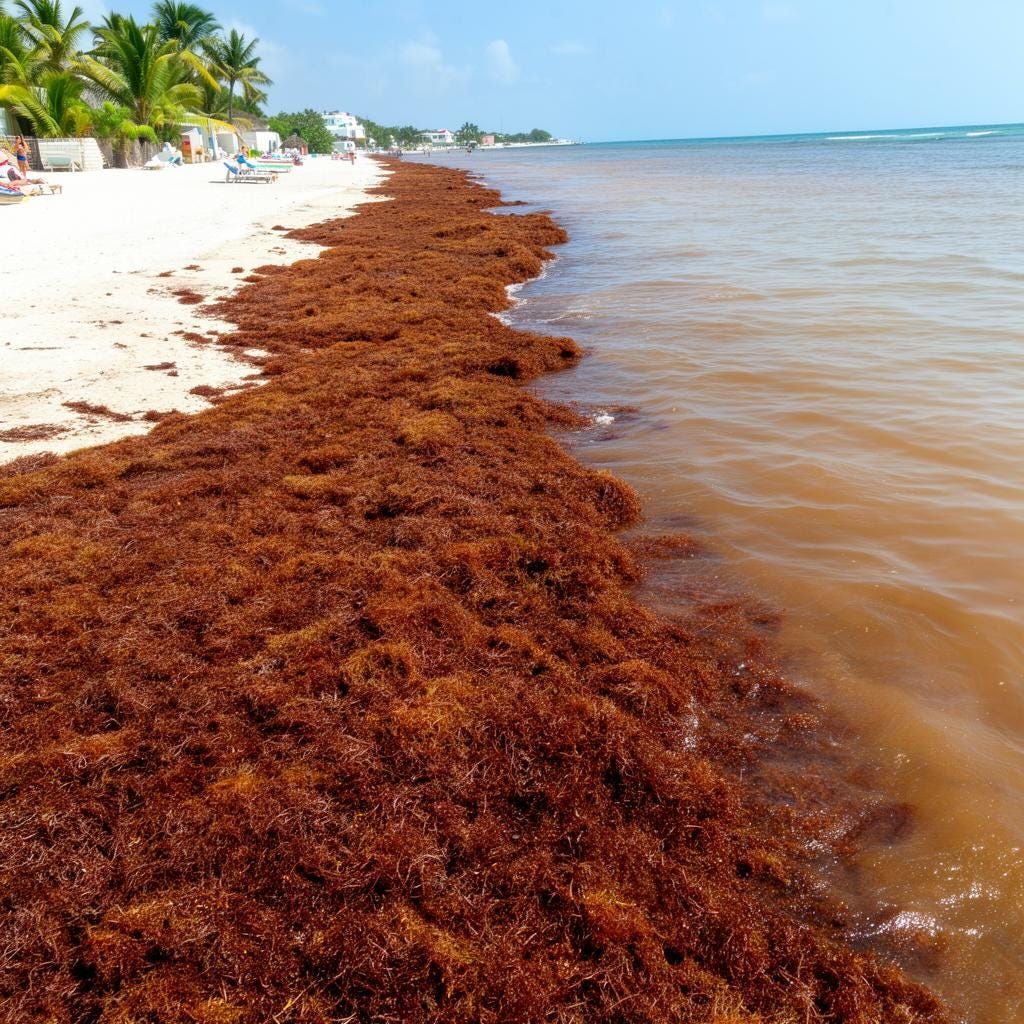
And then came the sargassum. It’s a floating brown seaweed that has always drifted in the Atlantic. Out at sea, it does no harm and gives fish and turtles somewhere to shelter and feed. Once it washes up, it rots in the heat, smells, and turns turquoise water the colour of tea.
The Mexican Caribbean barely knew it until about 15 years ago.
Around 2010, strong winds pushed sargassum out of the Sargasso Sea and into the tropical Atlantic, where it found the conditions to multiply. Since 2011, a band of it has formed most years between West Africa and the Caribbean, and scientists now call it the Great Atlantic Sargassum Belt.
By June 2025, it held 38 million tons.
Quintana Roo collected more than twice as much seaweed in 2025 as in 2024, and federal officials called 2026 the most difficult season yet.
For years, the response was tractors and shovels on the beach at dawn. In July, the federal government committed 2.6 billion pesos to a Navy-led plan to catch the seaweed at sea, with new ships, floating barriers and an early-warning system.
The plan is still ramping up. In July, President Sheinbaum admitted that more was still being cleared from beaches than caught offshore.
A destination with a loyal base can ride out a bad seaweed year. Tulum’s visitors already felt overcharged and fenced out, and the town recorded the highest crime rate in the state last year. The sargassum gave them one more reason to book somewhere else.
Built too fast?
Between 2021 and 2023, more than 80% of Tulum condos were sold off-plan, according to the real estate association AMPI. Aldea Zamá and La Veleta, two prominent locations in the village, were filled with studios built for short-term rental. It attracted local as well as foreign investors.
Now owners describe studios that no longer rent, and rents that don’t cover the mortgages on them. One long-term tenant in La Veleta told El Imparcial her rent fell 40% because her landlord would rather cut the price than lose her.
Some people mentioned that developers moved too fast and the government couldn’t keep up with what was being built. Paving, drainage, electricity, and internet all fell behind the construction. Infrastructure develops as a whole.
The guests who left first
This is how I read the Tulum case here.
Tulum’s name was made by people who stayed: the remote workers, the content creators, the wellness-focused travellers. They were the ones who turned Tulum into this sought-after Instagram destination between 2020 and 2022. As spotted in Riviera Maya News, “Many thought that digital nomads would be forever.”
A long-stay guest feels every local price again and again. Someone on a five-night trip can get flabbergasted by a 150$ dollar ride once. Someone staying a month and going to the beach twice a week makes dozens of those round trips, and pays the beach fee each time. They also need reliable internet, and, thankfully for them, they didn’t need to go far away to find alternatives.
Those were the guests filling the quieter months between peaks. Without them, the town depends on high season and first-time visitors, and first-time visitors need flights.
Investors are now pitching a “Tulum 3.0” built on luxury and wellness, with Aspen and Mykonos as the models.
Same country, different results
Two other Mexican destinations help separate what Tulum did to itself from what happened to the whole country.
Playa del Carmen, 45 minutes up the same coast, has the same sargassum and the same softer US demand, and it’s struggling too. In September, its small hotels were at about 18% occupancy. What Playa hasn’t lost is its flights, because it’s served by Cancún. The seaweed and the economy explain a bad year on the whole coast. They don’t explain why Tulum fell further.
Puerto Escondido, on the Pacific coast of Oaxaca, is growing. Visitor numbers rose 11% in the first half of 2026. It invested in access too. A new highway opened in February 2024 and cut the drive from Oaxaca City from more than six hours to about three, and the airport has been renovated. The difference is that Puerto Escondido was already a surf town with a reputation, and a World Surfing Reserve, before the road and the runway arrived. The infrastructure served demand that already existed. Visitors there still stay short,t and rents are rising, so I wouldn’t call it a finished model.
Where access followed an existing reason to visit, and the town stayed a town, demand held or grew. In Tul, um, the airport came first, and the town was rebuilt around short stays, and the visitors left as quickly as they came.
The airport came, and then the airlines left.
For a while it looked like a good bet. The airport handled about 1.2 million passengers in its first full year. But fast forward two years, and in the first half of 2026, traffic was down by a third on the year before.
The airlines have drawn their own conclusions.
Aeroméxico flew its last Tulum flight on September 30.
Volaris leaves in January 2027.
American is dropping its Miami route.
Cancún, two hours up the road, is expected to lose only about 3% of its air capacity this season. People are still flying to the Mexican Caribbean- but fewer of them are choosing Tulum once they land.
An airport makes arriving cheaper. What it costs to be there, and how it feels, is a separate problem, and that’s where Tulum lost it.
What is the lesson other destinations can learn?
An airport doesn’t create demand. It makes arriving cheaper and shows a destination’s strengths and weaknesses to more people, faster. Tulum got the arrivals before it fine-tuned its own experience. Taxis ran with no meters and no competition, the beaches got gates, and the building boom ran ahead of drainage and power. Nothing in the market rewarded anyone for staying longer.
The army broke ground on the airport in 2022. That left more than a year for the town, the state, and the hotel sector to answer some basic questions:
Why were thousands of units allowed to go up before the drainage, power, and internet to serve them?
Why did Uber only start operating in October 2026, three years after the state made ride-hailing legal?
Why does getting from town to the beach still depend on a taxi with no meter?
Why could hotels fence off beaches that Mexican law says belong to everyone?
Why was nobody counting how long visitors stayed, or whether they came back?
Questions like these are why destinations need professional guidance on strategy, policy, and execution on extended-stay products. The best time to bring that in is before committing massive budgets to infrastructure projects.
Miloš
PS: Do you know of a similar destination story to Tulum? Let us know in the comments - we would love to cover it!
Read the original on Substack →