Why Smart Cities Measure Resident Retention, Not Tourist Arrivals
Miloš Pelucha · Thu May 21 2026
“Once one starts to think about economic growth, it is hard to think about anything else." Robert Lucas
This quote comes to my mind about once a week - every time I sit down to write down my ideas for The Extended Stay. Talking to people from the industry - both the private and public sectors - I always find myself realizing that there is a huge, unrealized economic growth use case that could be executed through the community, extended stays, and infrastructure development.
Most economic development offices still report to their boards in arrivals, room nights, and total visitor spend. There is nothing particularly wrong with the numbers, but those are tourism metrics. They basically describe a building’s foot traffic.
If cities that are tackling population decrease or want to attract more talent are serious about it, these are not the KPIs to measure.
Tax base, business formation rate, long-term population, and capacity to retain the people who chose to live in it - these metrics are way more interesting to measure.
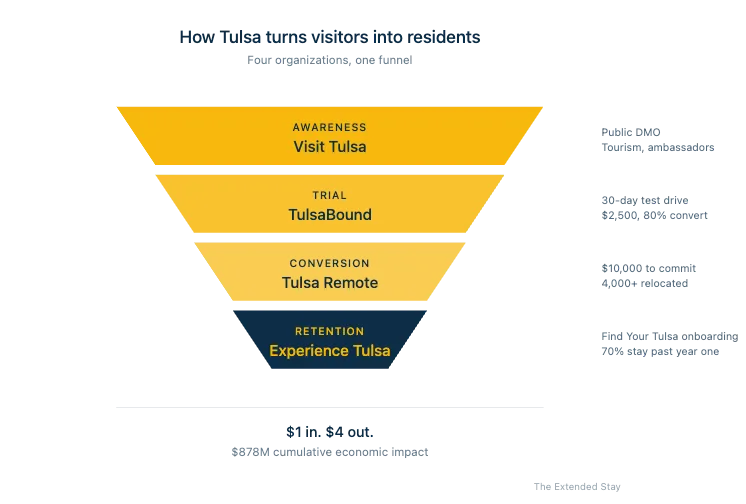
We covered the Tulsa case study in detail in a previous edition. 4-to-1 return on every public dollar spent to attract and retain remote workers, and the local visitor economy and resident economy run by multiple teams under one roof.
So, how should cities treat people who come with the intention of staying longer?
What Arrivals Actually Measure
An arrival is a footstep. It tells you someone showed up.
It does not tell you whether they came back, whether they paid local tax, whether they hired locally, or whether they opened a business that now employs your neighbor.
Simply, the economic impact is limited.
If you aim to make your destination busy in the summer or sell your rooms in July, that’s fine. Foot traffic is your product.
If an economic development team has an objective to grow the tax base, business formation, and long-term population retention, foot traffic is the wrong product.
Arrivals, average room nights, and total visitor spend. None of these metrics describes whether the local economy gained capacity.
Where Most Cities Get It Wrong
Let’s use a city that has seen massive growth in the past few years as an example.
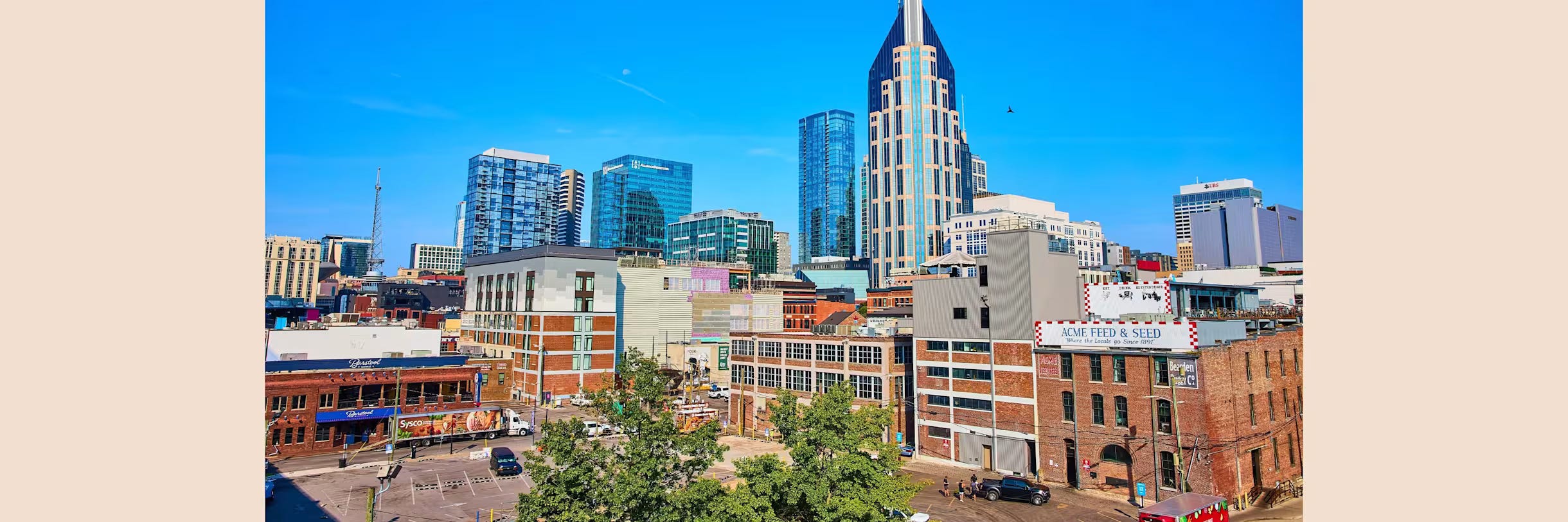
Like Nashville, Tennessee. Nashville’s population grew 15% between 2010 and 2024, adding roughly 90,000 new residents. Almost half of that growth happened between 2019 and 2022.
The median home price hit $565,000 by early 2024, up from $499,000 a year earlier.
Between 2010 and 2023, the city lost about 27,000 affordable units in the 30-to-60-percent area-median-income band.
The 2025 Unified Housing Strategy projects a need for another 90,000 housing units by 2035 just to absorb continued growth. A district councilmember called it the most intense gentrification of any city in the country over the past decade.
Nashville did not have an attraction problem. The number of arrivals kept rising while the conditions that retain working-class residents collapsed underneath it. The decision to upzone aggressively, in 2025, is happening after most of the affordability has already been lost. As much as FT is talking about “an existential crisis.”
Lisbon is another version of a similar story, just in a different country.
You might still find both cities reporting arrivals as the headline number. But less so about the missing housing supply.
What To Measure
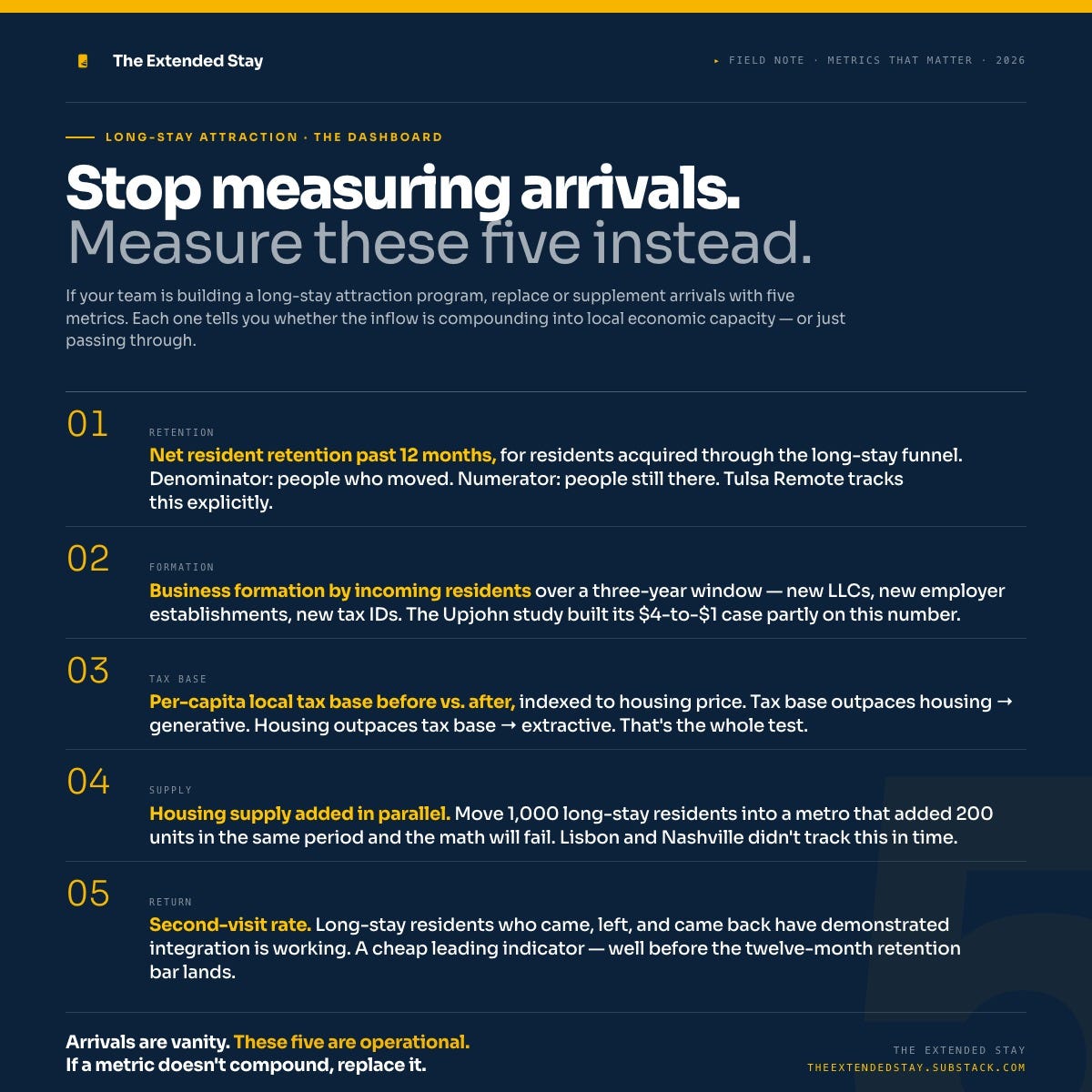
So, which metrics should destinations and cities looking to attract new talent and residents measure?
Here is a look at some of them:
More than a Visitor
So, who should the “cities of the future” aim to attract, if not the arrivals and visitors?
High-value travellers. These are the customers who actually buy their golden visa, or purchase residency options.
The cluster of high-value travellers includes
early retirees on geographic arbitrage,
founders between rounds,
sabbatical-taking senior professionals,
remote-working professionals,
families staging a relocation, and
recently exited founders deciding where to put their next decade.
They share a long time horizon, high disposable income, and willingness to integrate with the local economy.
They are early-stage residents paying tourist rates for the first ninety days.
Until your team has a working definition of who they are and what they buy, every program built for them aims at the wrong target.
Three Pillars Of Place-Making
A community that wants to capture this segment needs three things working together. None of them is marketing.
The first is economic literacy. Most economic development teams still cannot describe the segment in operational terms. Until they can, “we want to attract long-stay residents” is a wish, not a strategy. The first dollar should go to segmentation research. The compounding effect on every subsequent program decision is large.
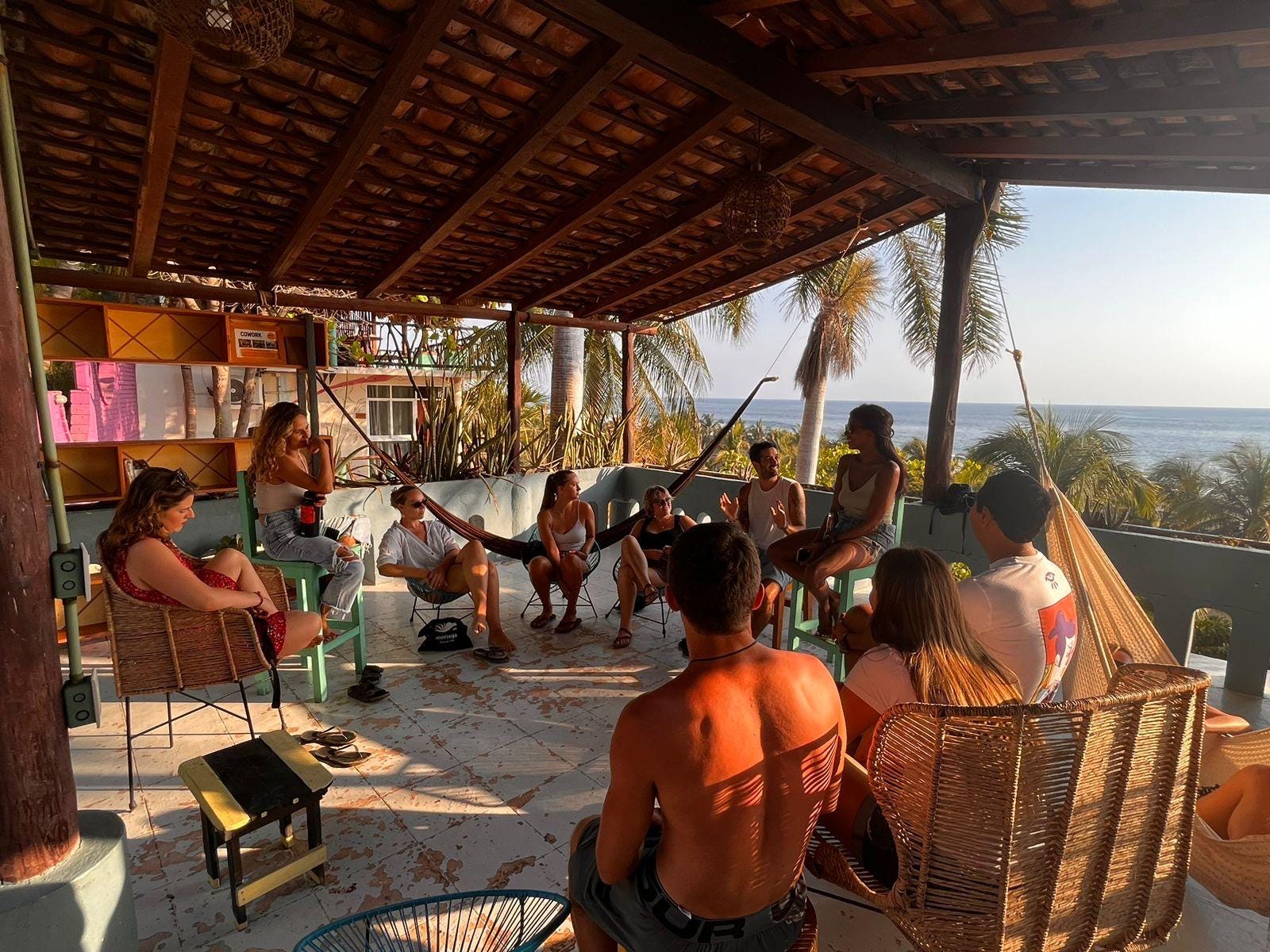
The second is social infrastructure. Integration is an economic asset that decides whether the person who landed for ninety days stays for ten years.
Cities that handle this build deliberate contact between newcomers and locals:
language exchanges
civic events
founder dinners
school partnerships
mentorship matching
Skipping that work produces the alternative: displacement, protests, and political backlash that end programs. Mexico City is now the case study for both ends of this spectrum.
The third is hard infrastructure, and this is where most programs collapse. Two layers.
Physical: connectivity, tiered workspace, and the layer nobody wants to talk about, housing supply elastic enough to absorb the inflow without pricing out existing residents.
Institutional: usable long-stay visa regimes, tax structures that reward residence and business formation, and university pipelines that feed local talent into the businesses incoming residents will start. Long-stay visa programs have proliferated globally in the past five years. John wrote a great piece on it.
The policy half is largely solved. The housing-supply half is the bottleneck.
If your attraction program does not include a parallel housing-supply program and a real integration program, you are not building a solution, but rather a marketing campaign.
The City Of The Future
There are many angles on how cities can build their communities and talents.
The main point is always: what kind of place are you building, and who are you building it for?
The cities and communities that build social infrastructure, and the physical and institutional capacity to take a person from “I came for a month” to “I built my next chapter here” - will have higher resident retention. That’s for certain.
Every visitor is a top-of-funnel resident.
Every resident is a top-of-funnel builder.
If you aspire to build such a city, perhaps it’s time to stop counting arrivals.
And it might be time to start counting the second visit and the business formed. And the overall impact on the local economy.
If you’re anyhow involved in the economic development of your city or your destination.
Define the segment in writing before you spend another dollar. Build housing supply and integration programming in parallel with attraction.
Do not just market your city and extend the invitation.
Because arriving at a destination is only the first part of the story.
Aspire to build future homes.
Miloš