Why 12 of the Last 14 World Cups Lost Money
Miloš Pelucha · Thu Jun 18 2026
Hey, Miloš here.
Same as every other person in the world - we started watching the World Cup last week. And we thought it would be cool to have a look at the World Cup through the lens of economics. And the impact that it brings to the local communities, cities, and districts.
Let us know if you’re interested in reading more similar content pieces.
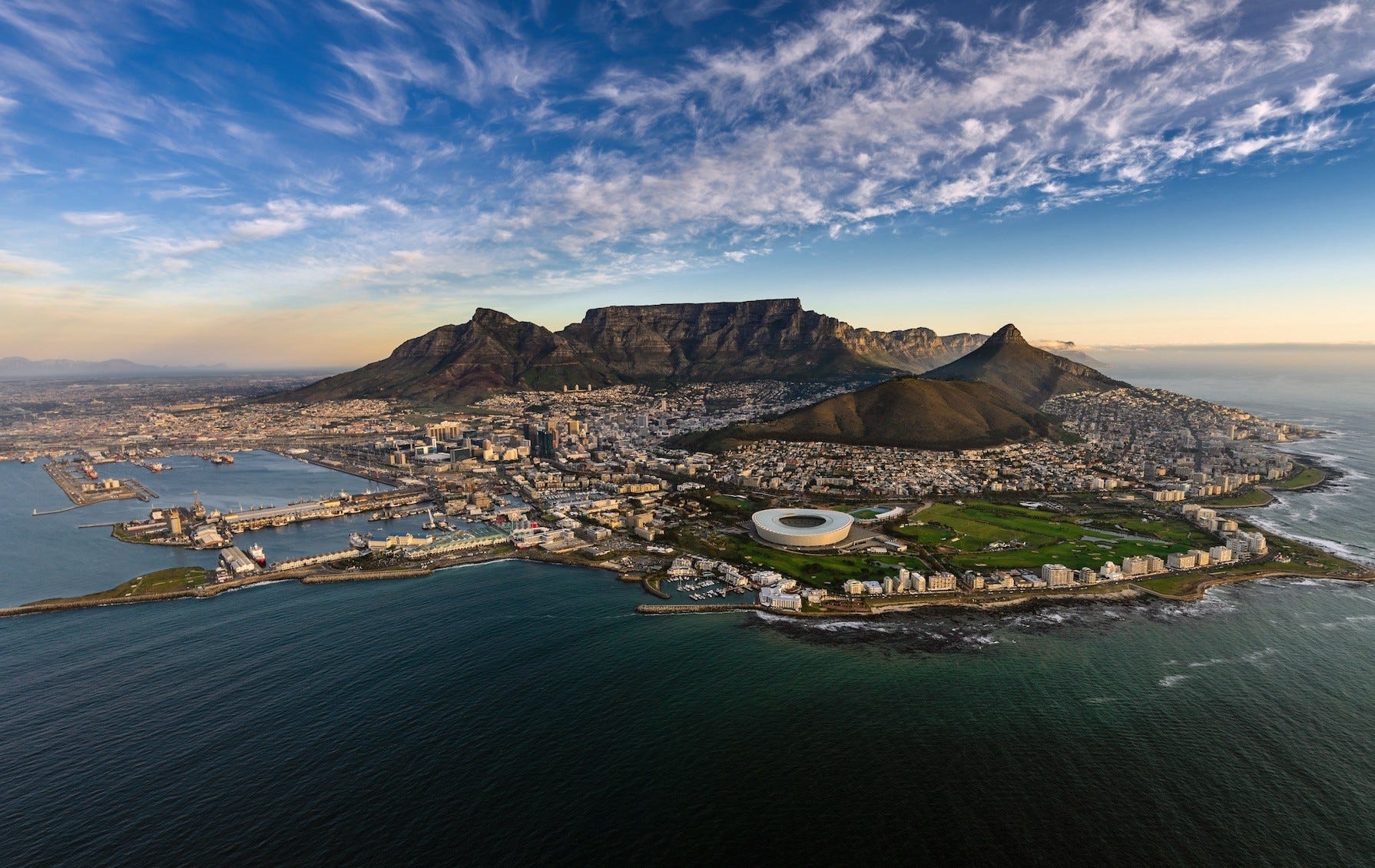
Cape Town built a stadium for the 2010 World Cup that cost around $600 million. Less than five years later, it sat largely empty, bleeding an estimated $6 to $10 million a year just to keep the lights on and the grass cut.
The matches played there were unforgettable. But that could not have been said about the maintenance invoice.
That gap, between the one-month event when the tickets sell out and the generation that services the debt, is the part of the mega-event story that nobody puts on their bid brochure.
Every mayor of a big city eventually hears the pitch. Host the World Cup, host the Olympics, and the world will finally see you. Tourism will follow.
“It’ll put us on the map.” The problem is that the people who study this for a living keep arriving at the same uncomfortable answer.
Economists are close to a consensus that mega-events do not pay for themselves. Robert Baade and Victor Matheson, two of the most-cited sports economists working today, have repeatedly shown that the benefits of hosting are overstated and the costs underestimated. By one tally, 12 of the last 14 World Cups since 1966 left their hosts with a net financial loss.
My own view is that the events still make sense for some hosts, but almost never for the reason they’re sold.
The spike is mostly people you already had
The number every host points to is arrivals. Visitors went up during the event, so the event worked. The trouble is that gross arrivals are the wrong number.
The number that matters is incremental arrivals: the visitors who came only because of the event, minus the regular visitors the event pushed away.
That second half is real, and economists have a name for it.
The substitution and crowding-out effect describes the football fan who books the city in July, partly replacing the ordinary traveler who decided to skip the crowds, the congestion, and the tripled room rates.
Locals leave town.
Conference organizers move their dates.
Higher-spending leisure visitors go somewhere quieter.
The net effect on direct spending tends to land close to zero-sum once you net out everything the event displaced.
The numbers back this up.
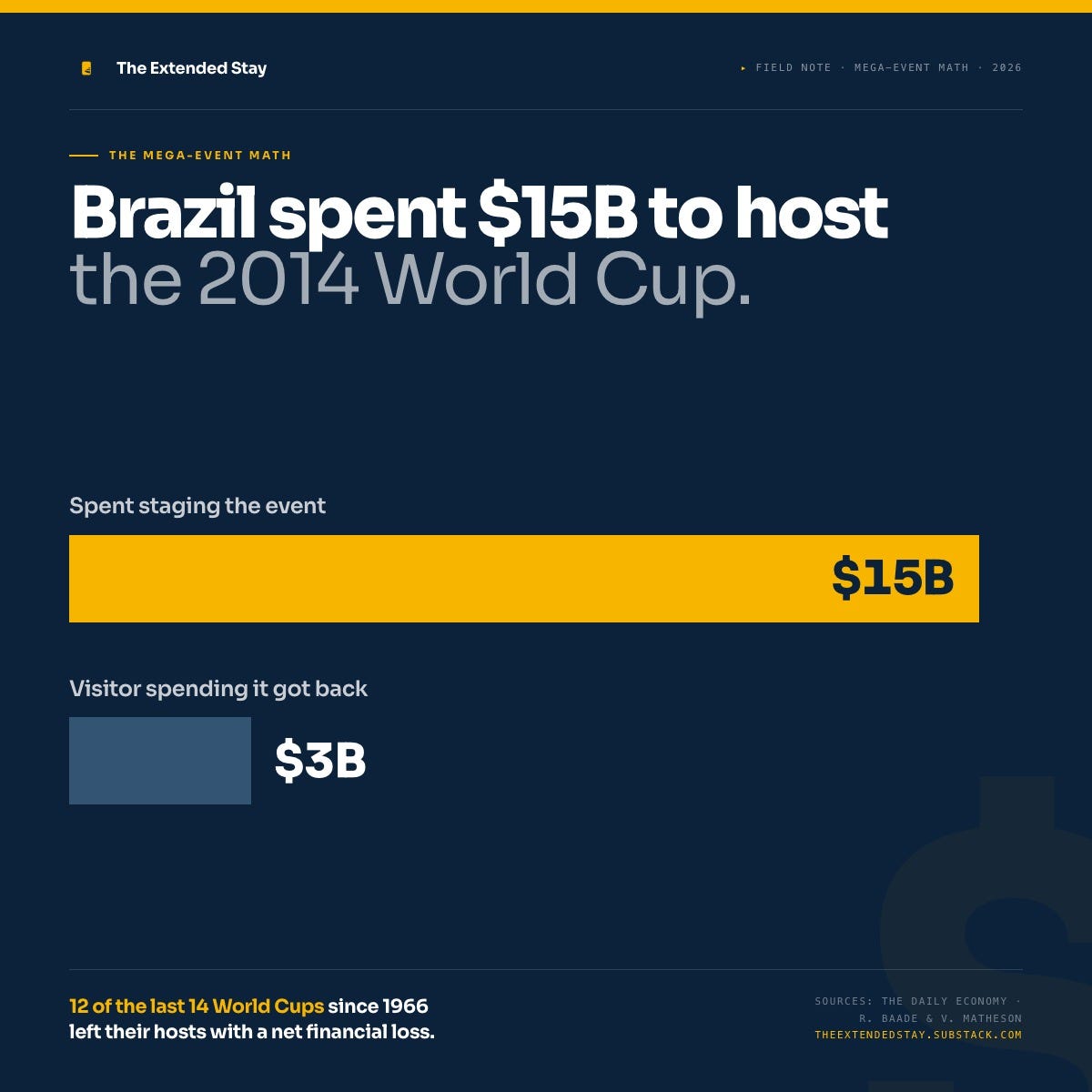
Brazil spent roughly $15 billion to stage the 2014 World Cup and saw about $3 billion in visitor spending in return.
A Clemson University study of the 1994 World Cup in the United States found that host cities, sold a $4 billion windfall, actually came out somewhere between $5.5 and $9.3 billion worse than promised.
The metric is not the number of people who showed up during the tournament. It is how many more showed up, net, and what they spent that your existing visitors would not have.
The stadiums don’t leave when the cameras do
The event lasts a month. But the infrastructure that costs hundreds of millions of dollars won’t go away. And it doesn’t always earn its keep.
South Africa built ten stadiums for 2010 at a cost of around $1.1 billion, and most of them now struggle to cover their operating costs. Cape Town’s Green Point is the headline case, but it is not alone.
Brazil built arenas in Manaus, Cuiabá, Natal, and Brasília, four cities with no top-flight football club to fill them. The Arena da Amazônia in Manaus cost about $220 million and spent its first post-Cup stretch losing money on near-empty fixtures.
Across recent World Cups and Olympics, operating and maintaining this stranded infrastructure has been estimated to cost taxpayers around $1.2 billion a year.
That is the line item the bid never mentions: not the price of building the stadium, but the price of being unable to demolish it. A venue with no organic post-event demand is not an asset: it’s a liability that the whole local community pays for.

The exception everyone cites, and why it doesn’t replicate
People who defend the mega-events have one answer to all of this, and it has a name. Barcelona.
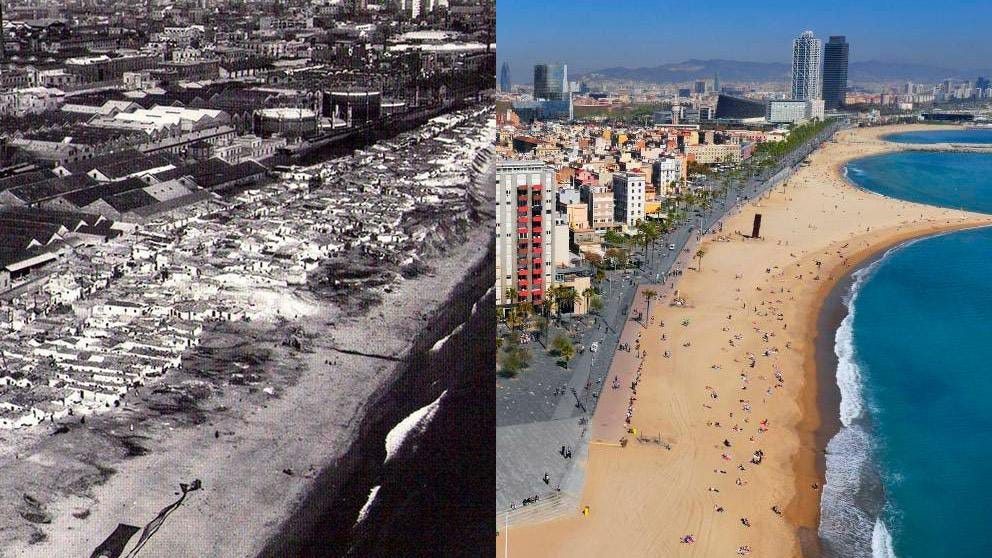
The 1992 Olympic Games were a genuine success story, and it was a catalyst to the city’s growth.
Visitor numbers in Barcelona were about 1.7 million tourists around 1990 and roughly 26 million by 2025.
The visitor mix flipped from mostly business to mostly leisure, and unemployment fell from 18.4 percent to 9.6 percent.
One thing is an extraordinary standout at this megaevent in Barcelona, though. Around 95 percent of the budget went into transport links and city infrastructure, not stadiums.
Barcelona used the Olympics as a deadline to execute an urban renewal plan it already wanted: open the city to its waterfront, rebuild the transit spine, modernize the airport.
That is the distinction that gets lost every time a city points at Barcelona. Barcelona did not win because it hosted the Games. It hosted the Games because it already had a plan, and the Games paid to fast-forward it.
Qatar didn’t buy a tournament; it bought a deadline
Qatar is the cleanest recent example of the accelerant logic.
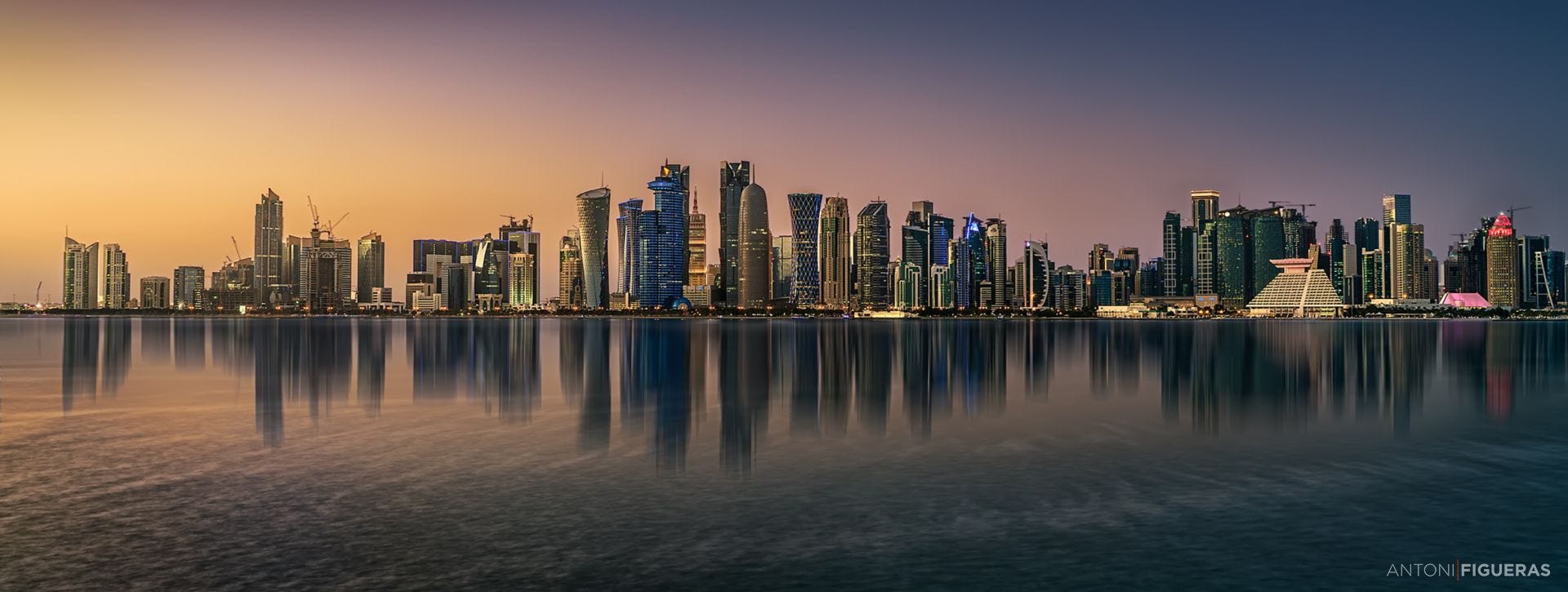
The $200 to $300 billion figure attached to 2022 was never the cost of the football. Stadium construction was closer to $6.5 billion. The rest was a decade-long national build-out, a new metro, an airport, a port, hotels, all of it timed to a date the whole world had circled. The tournament itself drew over a million visitors and generated between $2.3 and $4.1 billion, a rounding error against the spend.
But the actual goal sits in 2030: lifting tourism toward $35 billion and to 12 percent of GDP.
Whether Qatar hits that, nobody knows. But the structure of the bet is the right one to study. The event was the forcing function for a strategy that had to stand on its own afterward. The football was the loud part. The strategy was everything they spent the other decade building.
The capable hosts are quietly saying no
Here’s the part that should give any bid committee pause. The countries most able to host are increasingly the ones walking away.
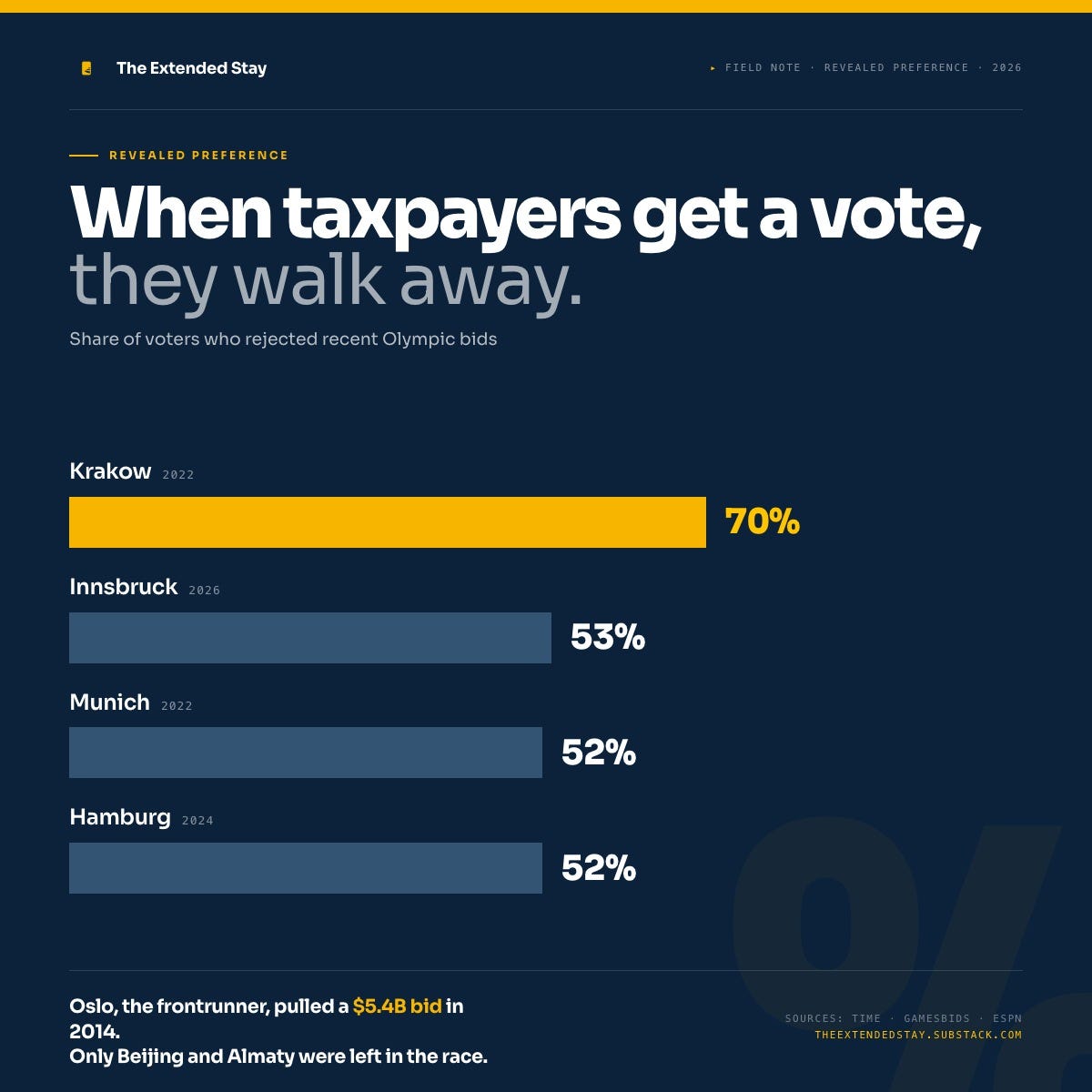
Norway is one of the richest nations on earth and a winter-sports superpower. For the 2022 Winter Olympics, Oslo was the frontrunner. Then, in 2014, the government pulled the bid. Prime Minister Erna Solberg said there wasn’t enough public support to spend 35 billion kroner, about $5.4 billion, on the Games. More than half the country was against it. Oslo’s exit left the IOC choosing between Beijing and Almaty. The question was never whether Norway could host. It was whether it was worth it.
And Norway wasn’t alone. Krakow pulled out with 70 percent of voters opposed, Hamburg killed its 2024 bid in a referendum, and Munich, Innsbruck, Stockholm, and Boston all walked too. Sort the recent declines and a pattern shows up: the higher a country scores on quality of life and democratic accountability, the more likely its taxpayers are to look at the bid and vote no.
That is the revealed preference that matters more than any economist’s model. The people who actually have to service the debt, when you let them vote, mostly decline.
The bid only looks like a prize until the people paying for it get a say.
So what to spend it on instead?
Decline the spectacle, and the question gets useful. What kind of visitor do you actually want, and what would it cost to attract them directly?
Start with the long-stay traveler. A digital nomad spends somewhere between $1,950 and $3,500 a month, and unlike the tournament tourist who’s gone in a week, that money lands in local cafes, markets, and rent, over months. A study of Greece’s digital nomad visa estimated that 100,000 nomads a year, staying six months on average, would generate revenue equivalent to 2.5 million week-long tourist stays.
The infrastructure for that visitor isn’t a stadium. It’s the same infrastructure Barcelona actually built with its Olympic budget: transit, housing, connectivity, a reason for skilled people to stay. Those things have users on an ordinary Tuesday, which a 40,000-seat arena in a city with no football club does not.
And the white-elephant test still applies, even here. Japan and South Korea, both perfectly capable World Cup hosts, poured public money into workation and coworking facilities during COVID, and plenty of it now sits underused. Purpose-built remote-work infrastructure can strand just as fast as a stadium if the demand isn’t organic.
What to actually do with this
If you run a destination strategy, the takeaway is not “mega-events are bad.”
Some hosts genuinely win.
If a bid would free a once-in-a-generation budget, will the thing you build with it still have users the day after the closing ceremony?
A stadium in a city with no club fails that test.
Transit, housing, connectivity, and a talent pipeline pass it.
For most destinations, most of the time, that math is the better bet. The event can amplify a strategy. It cannot replace one.
Miloš