This City Wants to Turn 3000 Visitors Into 3000 Companies
Miloš Pelucha · Thu Jun 04 2026

Every month, roughly 300 digital nomads land in Córdoba, Argentina. Most of them write code, run companies, or carry the kind of technical skill that takes years to hire for. For two years, the city’s official nomad program, Nomads Cordoba, has been an exercise to attract the audience of high-value visitors. This year, they started treating it as a pipeline of companies to add to the local tech ecosystem.
This shift is the whole story. Córdoba spent its first two years convincing locals that nomads mattered, then convincing the world that Córdoba mattered. Now the municipality is starting the harder thing: plugging those arrivals directly into the local technology ecosystem, betting that the transient remote-work crowd can be converted into founders who incorporate locally, hire Cordobeses, and leave value the city actually keeps.
I’ve watched a lot of destinations chase nomads for the Instagram of it. Córdoba is one of the few I’ve seen treat the nomad as an economic input rather than a tourism line item.
Here's how they got here, what they actually built, and where the strategy still has to prove itself.
Who’s running this, and why 🇦🇷 Córdoba is alone in Argentina
Structure explains the strategy.
The program is led by Maria Gabriela Sibilla, International Positioning Manager at Còrdoba Acelera, a municipal agency of the City of Córdoba dedicated to promoting the city’s international engagement. She leads three key international programs:
Acento Global
The stated mandate across all four is to position Córdoba on the global stage and strengthen its productive development. The nomad program isn’t a tourism campaign. It’s an autonomous entity (ente autárquico) belonging to the Municipality of Córdoba.
That placement is why Córdoba is the only city in Argentina running a program like this. “We are the only official program in Argentina nowadays,” Sibilla said.
Other Argentine cities that touch nomads at all do it through a tourism secretary, as a side function of a destination-marketing brief.
Córdoba runs it as a dedicated municipal program with a four-year government mandate and an economic-development purpose.
If you ask why it matters, a tourism office counts arrivals; an economic-development program is allowed to care whether those arrivals stay, hire, and incorporate.
Córdoba chose to play the longer game.
It needs that edge because the macro is working against it.
Argentina has gotten expensive in dollars, which dented its standing as a budget South American base.
The national government has pivoted away from nomads toward luxury travelers, so the federal tailwind that once existed has cooled, and the Buenos Aires initiative that helped seed the space has wound down.
Córdoba competes on the two things that survive a strong dollar:
It’s cheaper than Buenos Aires.
It’s close to nature.
“Many of those who travel to Argentina prefer to stay in cities like Córdoba more than Buenos Aires, because the cost of living is lower than in the capital (Buenos Aires),” Sibilla said. It’s also a university city, which gives the housing and ecosystem a second demand engine underneath the nomads.
Here is the number that defines the whole bet. Roughly 300 nomads arrive per month, a figure Sibilla’s team triangulates from Nomad List trends and its own registration form. But the program meaningfully connects only 20 to 30 of them in a given month. Ninety percent of the technical talent landing in Córdoba currently passes through without ever touching the ecosystem the city is trying to build. The entire year-three strategy is an attempt to widen that conversion rate, to turn that into retention and retention into company formation.
The takeaway for secondary cities: where a program lives inside the government determines what it’s allowed to optimize for. Córdoba put its nomad program under the economy department, and that single choice is why it can chase companies rather than bed-nights.
How Córdoba built the demand: a 3-year arc
The program wasn’t always this ambitious. It was sequenced like a product roadmap, and each year had a concrete job.
“When we started this program two years ago, we said, first of all, we need to put the nomad concept in the city, because there are many people here in Córdoba who don’t know what a nomad is, what they do, why they are important for the city.”
Gabriela Maria Sibilla
Year one was definitional. The team held a congress in Córdoba with international speakers to explain nomadism and connect local companies that were already quietly employing remote workers from abroad. The goal was to make a foreign concept legible to the local people and partners.
Year two pointed outward. The program organized an international forum and brought in connected nomadic voices to put Córdoba on the global map as a destination. This was the awareness-to-the-world phase, and it ran in parallel with the part of the strategy a DMO will actually want to copy: a private-sector benefits network.
Córdoba signed up local partners across hotels, colivings, coworking spaces, gastronomy, gyms, cafés, nightlife, and Spanish-language schools, then bundled those perks for registered nomads. On top of it sat a programming layer of activities, including trekking and sports organized in the smaller towns 30 to 40 minutes outside the city, built around the nature that nomads kept citing as the reason they liked the place. That benefits network is the engine that strengthens Córdoba’s positioning. The demand showed up in the private market, which is the cleanest proof that a strategy is working. A local partner who opened Córdoba’s first coliving opened a second one late last year, with demand split between nomads and international students. When a private operator doubles their bet with their own capital, the public program is doing something right.
Takeaway for secondary cities: the benefits network is the replicable part. You don’t need a four-year mandate to sign twenty local businesses to a perks card and give arrivals a reason to identify themselves to you. That registration is the top of every funnel that follows.
Phase three: plugging nomads into the tech ecosystem
This year, Cordoba chooses to pivot from perks to integration. First steps have already started through their Meet & Learn initiative.
The team takes registered nomads inside local technology companies to see how they operate, and local firms run workshops in return. It’s the first step of the mechanism meant to convert that 20-to-30 monthly connection rate into something larger.
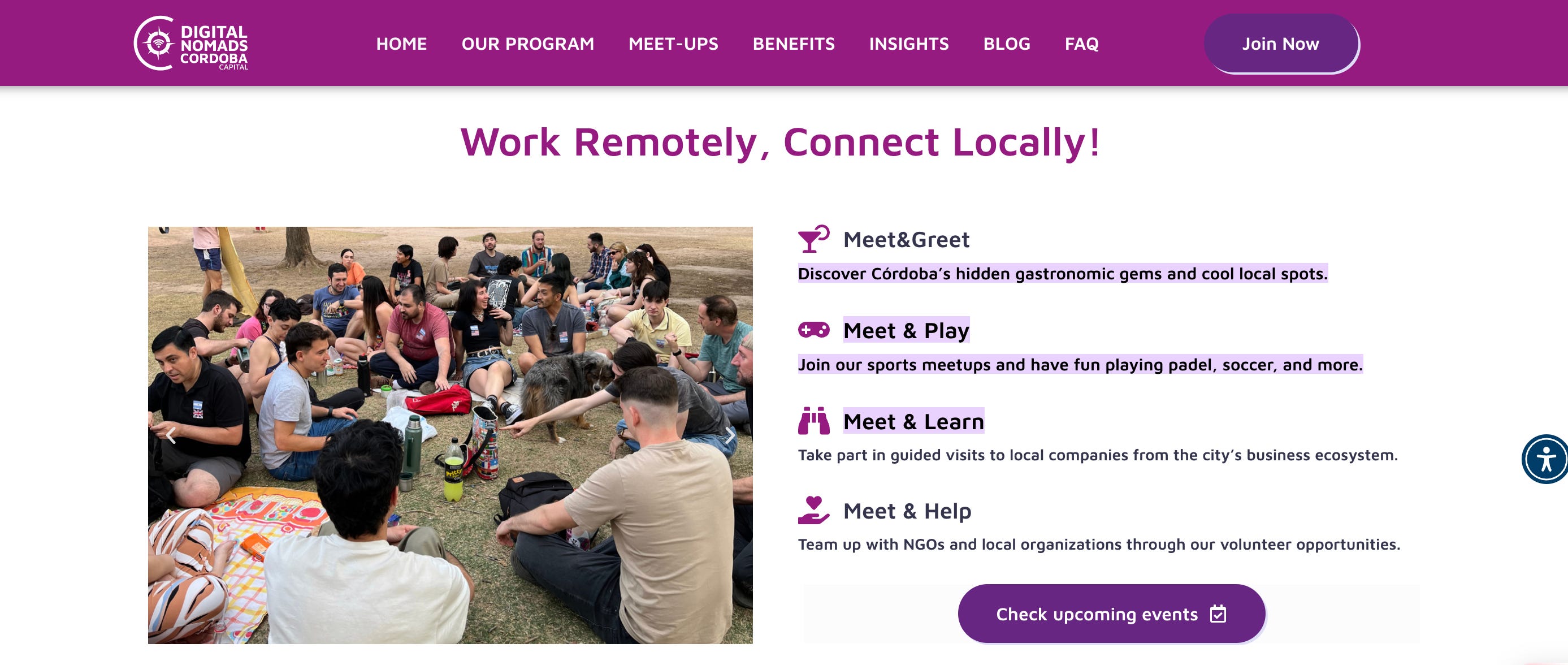
The one real signal so far is a behavioral one, and it’s encouraging. “In this kind of activity, most of the people who register are nomads,” Sibilla said. The pull toward the local ecosystem is coming from the nomads themselves, not being manufactured by the program. When the people you’re trying to retain are the ones signing up to get closer to your local employers, you have demand you haven’t fully met yet.
The explicit goal is company formation. “That means the nomads stay here, they start to maybe contract Cordobeses to work for their companies, and the companies they build are always related to technology,” Sibilla said. The program wants to optimize for the incorporation of nomads who arrive, stay, and turn into local employers.
Meet & Learn’s only measurable output today is registration interest. There’s no published number on how many nomads have incorporated, hired locally, or converted to residents because of it. The “doubling down” is real in intent (more company visits, more workshops, deeper ecosystem ties over the next two years), but it isn’t yet backed by a tracked conversion figure. Year three is the year that has to change.
What Córdoba hasn’t built yet
I’d be doing the program a disservice if I called this a finished case study. It isn’t, and the gaps are instructive.
The promotion is relationship-driven, not yet a system. Córdoba reaches nomads through Nomad List, its own registration form, an active events calendar, an Instagram presence, and partnerships with the local tourism secretary and Visit Argentina(national tourism bureau).
It’s a collection of channels, but perhaps not particularly a designed funnel with a paid trial, a conversion offer, and a relocation program like Tulsa Remote runs in the United States. Córdoba has the inputs to build that funnel. It just hasn’t productized the path from “visited” to “moved here” yet.
There’s also no formal incentive at the bottom of the funnel.
No founder tax bracket. Yet.
None of that sinks the thesis. It means year three is the year Córdoba has to start counting and systematizing what it has, until now, mostly built by hand.
Lessons for secondary city economic development
Most destinations measure nomad success in arrivals. Córdoba spent two years doing the same thing and earning the right to measure something better: how many of those arrivals stay and build.
Three hundred technically skilled people a month is 3,600 a year. Every one of them is a possible company.
A city that converts even a low single-digit percentage of that into local incorporation is running a quiet economic-development engine that no tourism campaign can match.
It isn’t proven yet, and it isn’t as systematic as the best version of this will eventually be. But Córdoba put its nomad program in the economy department, built a real demand machine before trying to monetize it, and is now the only city in its country attempting the conversion at all.
If you run a secondary city and you’re still counting bed-nights, this is the model to watch and to beat.
Miloš