Why Pittsburgh Markets to a Mindset Instead of a Demographic
Miloš Pelucha · Thu Sep 17 2026
In today’s piece on the relocation program in Pittsburgh, you will learn:
Why a city that lost more than half its population can’t wait for organic growth.
Who Pittsburgh Tomorrow markets to, when it refuses to pick an age bracket.
Why “low cost of trying” is a different pitch from “cheap city.”
Why they built tools for people who had just arrived before they ran a single awareness campaign.
How this weekend’s Homecoming tries to turn visitors and ex-locals into residents.
…and now, back to this week’s story 🇺🇸
More than a century ago, my ancestors left rural Slovakia for Pittsburgh. Like thousands of Slovaks and other Europeans, they went for steel jobs.
The city they moved to has since lost more than half its people. In 1950, Pittsburgh was home to about 677,000. Census estimates now put it around 303,000.
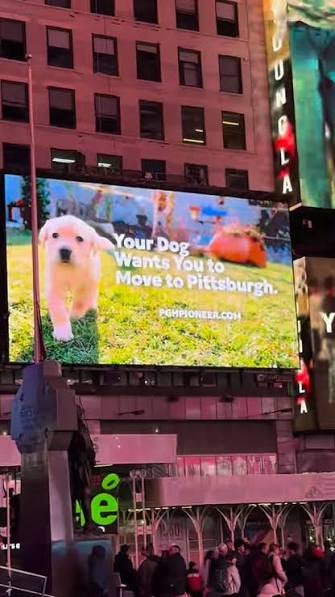
Cities across the U.S. are competing for the same movers. Tulsa pays remote workers $10,000 to move there. Pittsburgh put up a billboard in Times Square that said: “Your dog wants you to move to Pittsburgh.”
I spoke with Caroline Fisher, Head of Storytelling at Pittsburgh Tomorrow, the nonprofit behind that billboard, about what Pittsburgh offers and why it targets the mindset rather than a specific demographic..
Why Pittsburgh Can’t Wait for Organic Growth
Pittsburgh was the center of American steel. In the 1970s and 80s, the industry collapsed; mills and plants closed one after another, and four decades of slow decline followed.
Even in 2026,- the damage that remains is demographic. The region has long been battling natural population decline. An aging population doesn’t just fix itself. Someone has to arrive.
Pittsburgh Tomorrow is an organization that was born to solve this. It was founded by Douglas Heuck, a longtime regional journalist who spent more than 20 years reporting population benchmarks. “He got tired of writing about the same story every single year,” Caroline told me. So he decided to do something about reversing it.
His work has slowly found backing from more individual Pittsburghers. Whether they wanted to support the organization financially, or contribute to its mission by their work, connections, or other contributions, Pittsburghers got busy convincing other Americans to give this city a chance.
The pool of movers is shrinking.
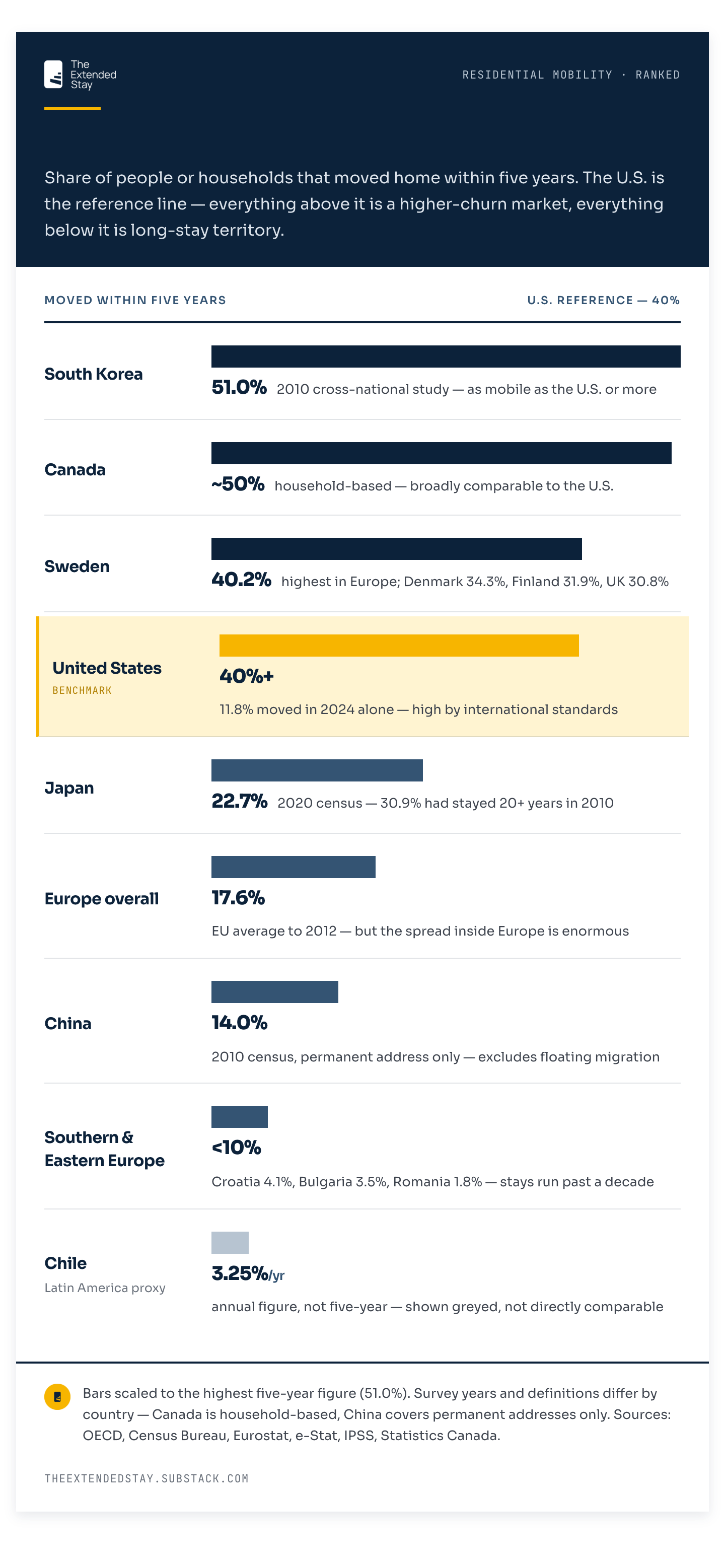
Americans have a reputation for moving constantly. That reputation is getting out of date.
They are still relatively mobile, but much less so than the familiar “moves every few years” stereotype. In 2024, 11.8% of U.S. residents changed address in the prior year - that’s roughly one person in nine.
Back in 2007, mobility rates produced the widely repeated estimate of 11.7 move-years over a lifetime. That lifetime number is not a current count of physical moves, and it likely overstates what today’s lower-mobility cohorts will experience.
However, the residential mobility in the U.S. remains high as residents often move for college, jobs, partnerships, business opportunities, climate, etc.
Hence, the pitch matters more than the check.
Targeting a mindset rather than a demographic
Pittsburgh Tomorrow doesn’t target an age bracket or an income band. It targets a profile they call “the pioneer.”
“We say that we don’t target any specific demographic,” Caroline said. “We’re looking for that psychographic type of person.” You can also see it in her social series profiling founders, artists, and small business owners. The people she features keep landing on the same line: they can't believe they were able to do this here.
The feeder markets fall into two groups:
people priced out of high-cost cities
people in small towns who want small-town feel with big-city amenities.
Caroline’s shorthand for Pittsburgh is “the East Coast of the Midwest.”
Most relocation campaigns I've looked at define who they want to reach. Very few define what that person is looking for.
Pittsburgh’s Pitch: Low Cost of Trying
Given the rise in opportunity and the search for residents amongst other US cities - like Tulsa or Detroit - the pitch itself is important.
Caroline talks about Pittsburgh in brand-promise terms. The promise isn’t “cheap city.”
It’s that you can build something here without mass funding or generational wealth.
“Rent for storefronts can be affordable,” she said. “The startup costs of starting your own business and living your dream and not doing that classic nine-to-five life is still very possible in Pittsburgh.”
City Hall is pushing the same message. Mayor Corey O’Connor has made cold-calling startups part of his job. The city still courts corporate relocations, but the energy has moved toward people who come to start something of their own.
This pitch is a stronger pitch than affordability alone. Affordability attracts people escaping something. A low cost of trying attracts people building something.
And builders are the ones who hire, sign leases, plant roots, and eventually, stay.
They Built the Funnel Backwards
Pittsburgh Tomorrow didn’t start with a “why move here” website. It launched lifeinpittsburgh.com as a set of tools for people about to move or just arrived.
Jobs412 pulls postings from 42 job boards and sends applicants back to the original listing. There’s an events calendar, a volunteer finder, a utilities tool for a region split across many separate municipalities and boroughs, and a neighborhood finder in the works that matches your current neighborhood to comparable ones among Pittsburgh’s 92.
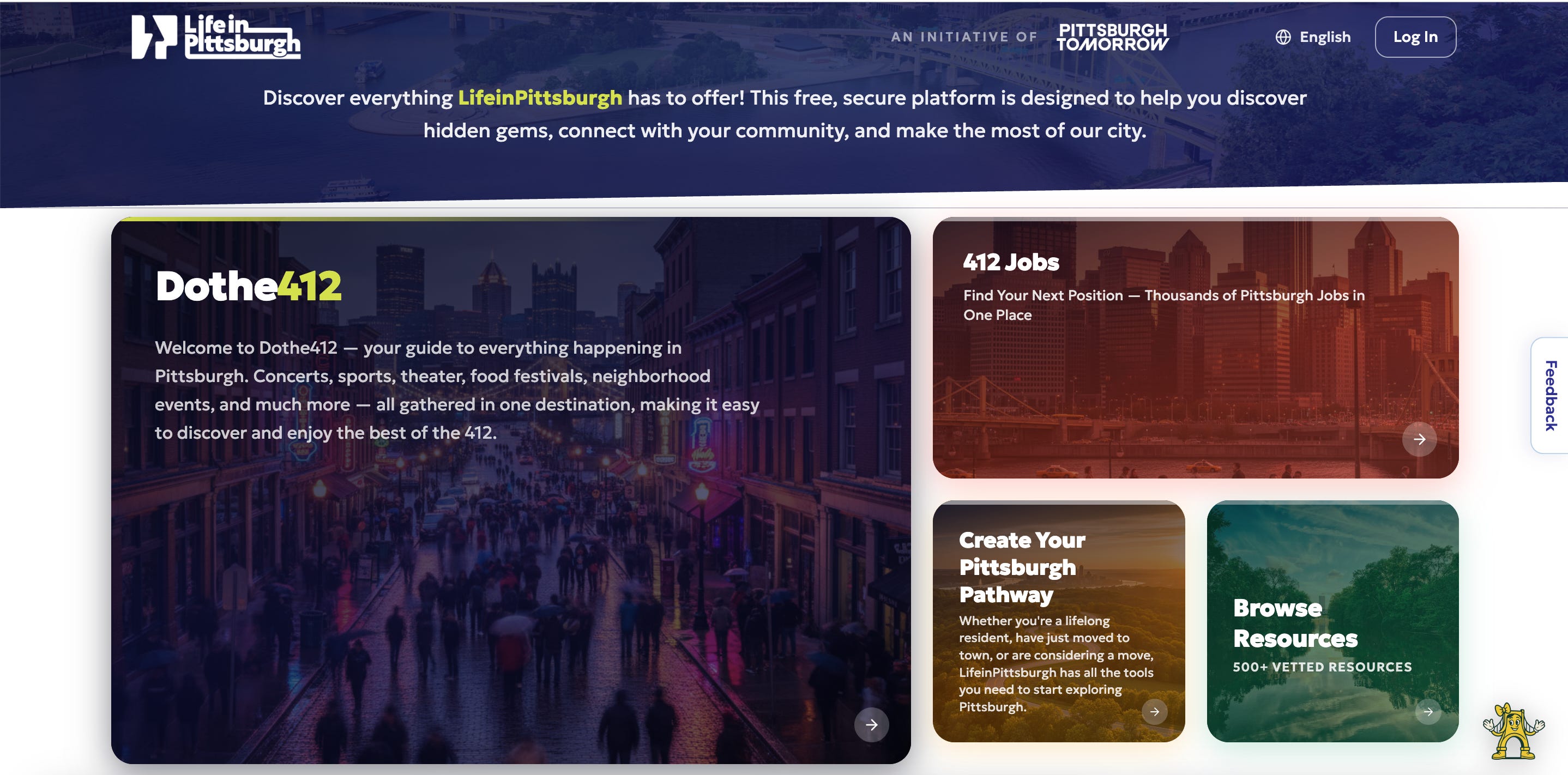
The reason is what newcomers told them upon moving to town. Things in Pittsburgh are hard to find, online and on the ground, where the streets don’t follow a grid.
When they showed partners, including the city, the utilities tool, the response was that people had been talking about building it for years. This is just another example of what the right use of AI can achieve in place-making and a community approach.
The awareness layer about PittsburghTomorrow only started later.
If you ever moved cities, states, or countries, you know how important the first 90 days are. If a new resident can’t find a job board, a volunteer shift, or where to drop off bulky trash, the billboard only paid for the move, not the stay.
Turning Weekend Visitors Into Residents
Pittsburgh Tomorrow isn’t the tourism bureau, and it’s not trying to be.
It meets regularly with Visit Pittsburgh, which fills hotels for events like the NFL Draft. Pittsburgh Tomorrow’s objective is to convert some of those visitors into residents.
The organization is testing out an interesting program this weekend.
Pittsburgh Homecoming runs September 18 to 20, at the end of a week when innovation events that used to run separately (CMU Startup Week, AI Horizons and others, organized with about a dozen partners) happen together for the first time. Homecoming adds an immersive art party at Rockwell Park.
Fourteen cultural partners, including the museums, the zoo, the botanical gardens and the Pirates, are giving free tickets to people coming in from out of town.
The audience is boomerangs (locals who moved out but think of coming back) and potential boomerangs. Caroline is one herself. She left for North Carolina, then Boston, then New York, and came back.
The next step in the programming development is a physical third space for newcomers and a one-to-one ambassador program that pairs new arrivals with long-time residents for a year. Pittsburgh isn’t short on coffee shops, and Caroline will argue it has “the best dive bars in America.” What it doesn’t have is a place built for people who just got there.
Lawrenceville, the Strip District, and Bloomfield are already where newcomers, remote workers, and long-time residents mix.
This is where operators come in. A weekend shows someone the city. A 30 to 90 day stay tells them whether they can live there.
What I’ll be watching
The organization is young, and there’s no public number yet for how many people have moved because of it. Pittsburgh is also in an increasingly competitive sphere for the same movers as Tulsa, Detroit, and every state with a relocation brand. Some of them provide financial incentives - some others.
Caroline doesn’t pretend otherwise. “In the US, we’re probably all competing for residents,” she said. “But I want to talk to the people from other cities, states and be like, what are you guys finding?”
Here’s what I’ll be particularly interested in tracking: how many out-of-town visitors Homecoming actually brings in, whether the ambassador program launches and fills up, and whether Pittsburgh Tomorrow starts reporting relocations.
It will be interesting to see how the pitch does.