Sauna Will Not Raise Your Rate
Miloš Pelucha · Thu Aug 13 2026
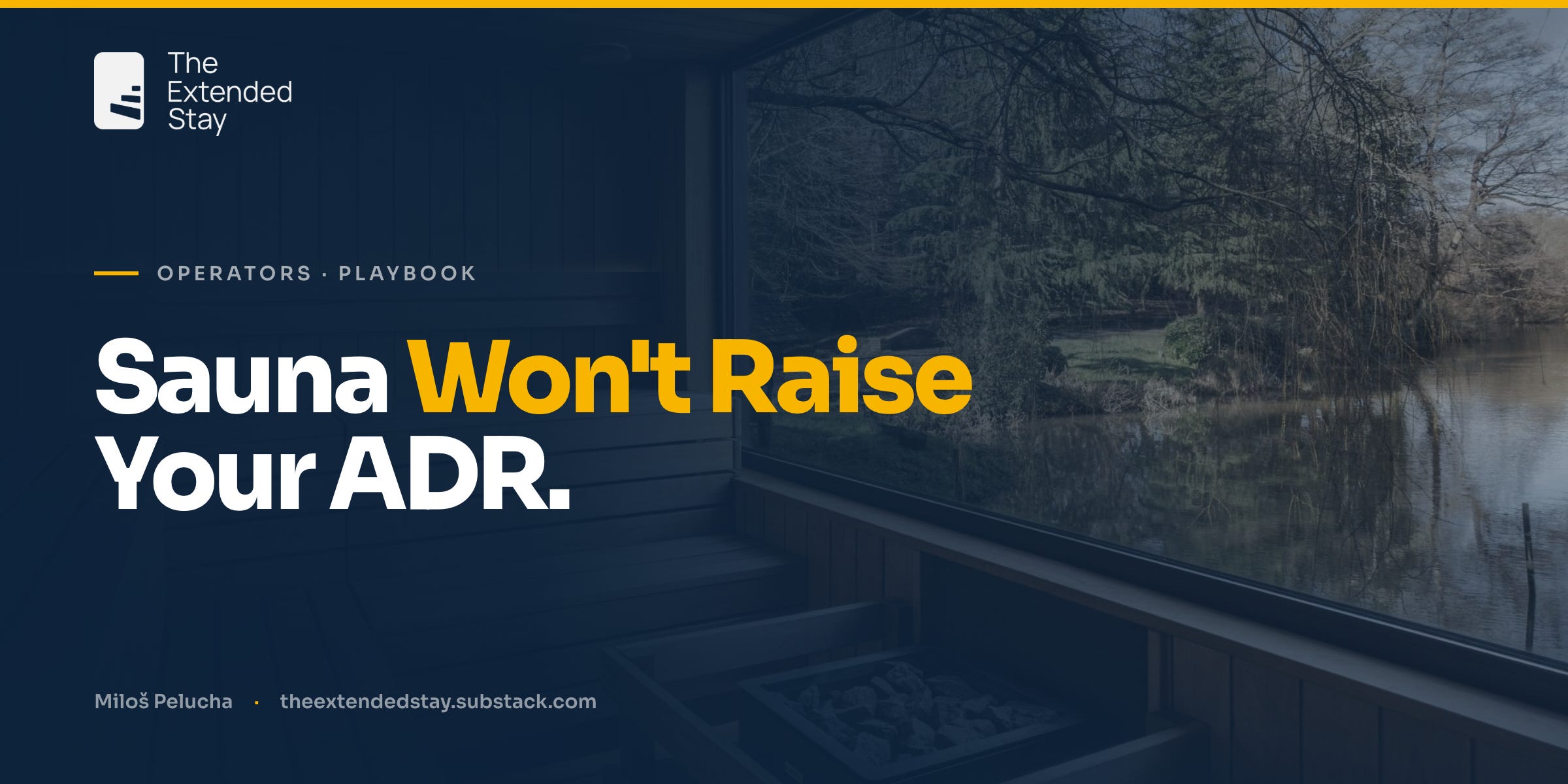
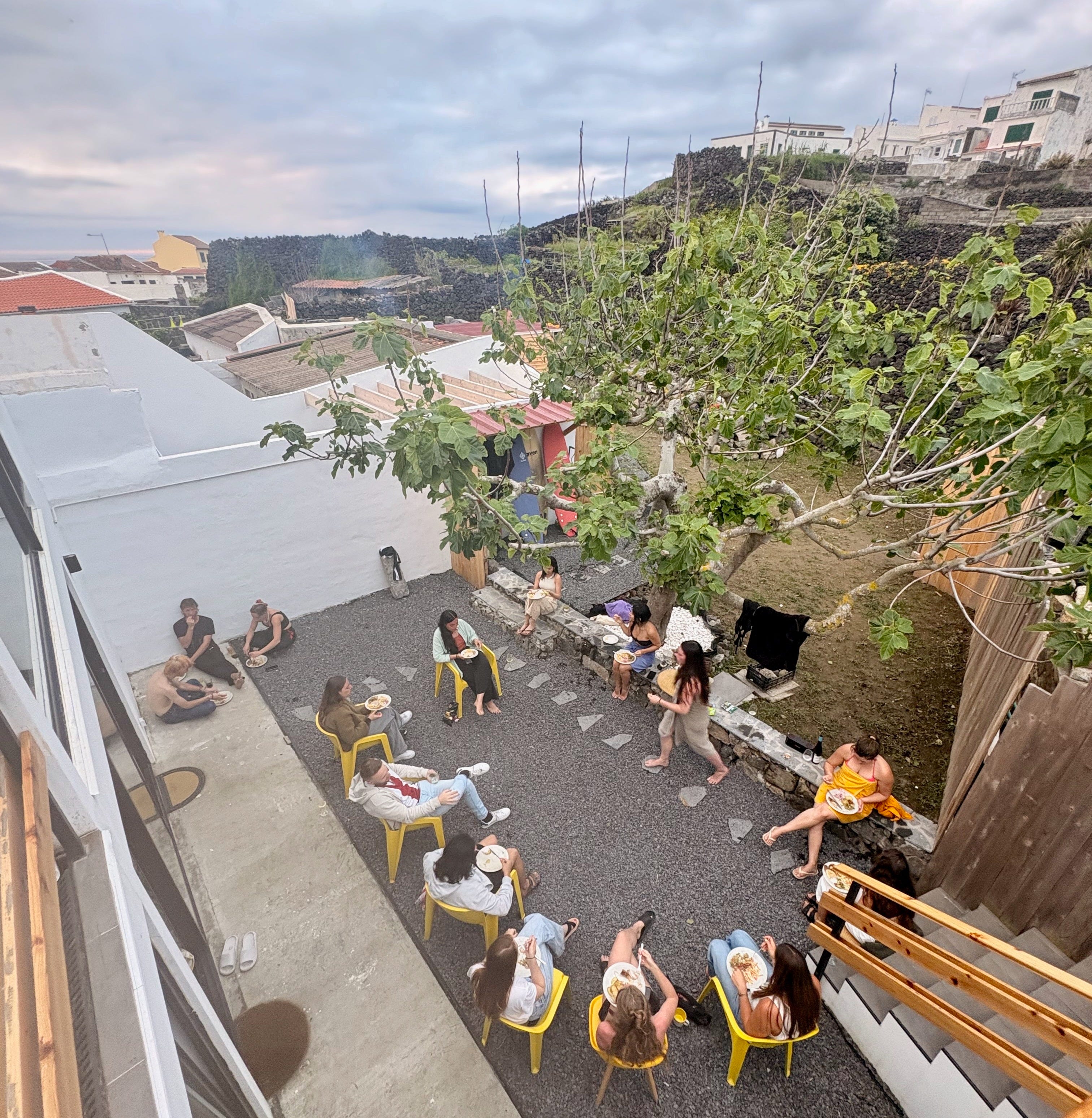
Every Sunday at LemonBros coliving, there are 6 to 12 people lining up to go to a sauna.
Half of them are not our guests. They’re locals, expats living on the island, or guests from our partner coliving who heard about the sauna session.
This happens every week, sometimes twice. It’s the single most reliable thing on our community calendar, but it doesn’t appear anywhere in our nightly rate.
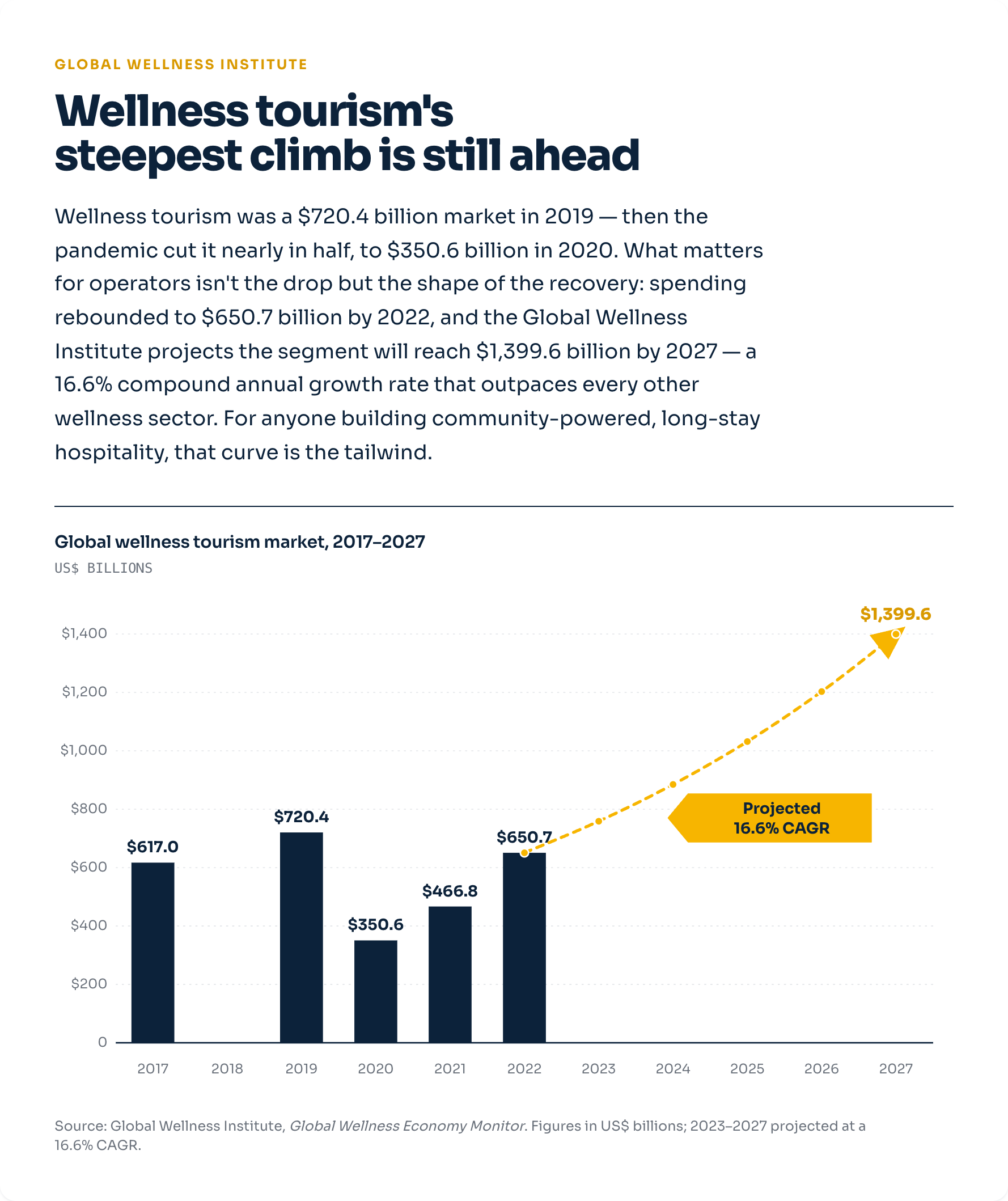
Wellness has been pulling the travel industry upward for a few years now.
The Global Wellness Institute put the whole wellness economy at $6.8 trillion in 2025, with wellness tourism accounting for close to a tenth of it.
Every operator I speak to has read some version of that number and drawn the same conclusion: put in a sauna, a cold plunge, or a gym and charge more.
I think that’s the wrong read. But there is still a massive value coming out of it nonetheless. So how to read it?
Where this trend actually came from and who it’s carrying
The trend didn’t start in hospitality. It started when the places people used to gather stopped working.
Run clubs were first to prove it. Free, structured, recurring, sober, and social. They demonstrated at scale that people will reorganise their week around a third place if someone builds one worth showing up to. Othership took the same insight into heat and cold. They went from Toronto to New York, and built something closer to a bathhouse crossed with a nightclub than a spa.
Two different groups are driving this, and they want different things from the same room.
The twenties and thirties are drinking less, and that leaves a hole in the week where the pub used to be. They are not “paying to work out”. They’re buying a reason to be somewhere at a fixed time with other people, and the sweat is the excuse that makes it socially legible. They check whether there’s a schedule before they check whether there’s a facility. They will pay for the room and not the drink, which is the exact inversion of the economics most hospitality F&B was built on.
The forties and fifties are buying sleep, stress management, and recovery without a prescription. Around 60% of consumers now rank healthy ageing as a top or near-top priority, and that isn’t confined to older cohorts. Traditional and complementary medicine, which is where most longevity and biohacking spend lands, is one of the fastest-growing categories in the wellness economy.
What the two groups share is the part operators keep missing. Both want to do it near other people. Community comes first, while facilities come second.
Simon Saunders, VP Strategic Health and Wellness at RLA Global, described the change plainly in Hotel Business Review this May: “Most health-conscious travelers no longer accept that their trips interrupt or break their daily training, sleep or nutrition routines.”
He points out that guests increasingly travel wanting to improve performance rather than pause it, and that many now try practices on the road specifically to take home afterward.
That’s a different customer than the one hotel F&B was designed for.
The old model assumed the guest arrives, works or sightsees, and converts to margin at the bar between 6 pm and 11 pm. The new one trains at 7am, wants macro-transparent food at an hour the kitchen is closed, and is in bed by ten because the sleep score matters more than the second drink.
Capital has already moved, and you can see it in who is building.
Equinox went from luxury health club into hotels. SIRO, from Kerzner, built hotels with fitness and recovery as the core product rather than an add-on. Around them sit four club archetypes now brushing against hospitality:
urban performance clubs li
athletic country clubs
longevity and medical clubs
social wellness clubs
Saunders calls the convergence “clubification,” and I think that’s the correct word for it.
Who is actually buying this, and where are they from?
North America held roughly 36% of the global wellness tourism market in 2025, and the US led it. Per capita wellness spending in the US passed $6,293 in 2024. On the real estate side the picture is the same: the US is the largest wellness real estate market at $254 billion, ahead of China at $218 billion and the UK at $51 billion.
Two other numbers matter more for a small operator. Wellness travellers spend meaningfully more per trip than conventional travellers, and millennials and Gen Z overweight wellness in their discretionary spending relative to almost every other category. That combination, higher spend and younger buyer, is the reason this trend has legs beyond a cycle.
The fastest-growing markets are elsewhere. Italy, Spain and Saudi Arabia posted the biggest gains in wellness real estate between 2019 and 2025, and the Gulf is growing faster than anywhere.
If your lodging operation is in Europe and your direct channel isn’t set up to convert US visitors, the amenity won’t save you. Build the sauna, keep selling to the same three European feeder markets, and you’ll have bought yourself a very expensive shed.
The revenue is real. It just doesn’t arrive where you’re looking for it.
You’ll find claims that adding an outdoor sauna or hot tub lifts ADR by up to 30% and occupancy by 15%. You’ll find claims that a sauna can add $50 to $100 per night to a vacation rental's rate. You’ll find a figure that 72% of travellers say wellness amenities influence where they stay.
Trace those back, and they almost all originate on the blogs of sauna manufacturers and vacation rental amenity vendors. They’re marketing.
I’m not arguing this doesn’t pay. I’m arguing the payback sits in three lines, and the one everybody underwrites is the weakest of them.
The first line is low-season occupancy, and it’s the biggest. Saunas perform hardest in the months when nothing else does. Cold weather, low season, bad light, no beach. In the Azores, that’s January-February.
The second line is non-guest revenue, and it’s the one almost nobody models. Sessions sold to locals, to people staying at other properties, to your partners’ guests. It’s small per head, and the actual benefit is more of an awareness than profit.
The third line is the direct channel, and it’s the hardest to attribute and the one I’d defend most strongly. The weekly session is the reason people who came once come back, the reason they talk to their friends about our place and why they don’t mind the season they would come in. I’m almost 100% sure that LemonBros is the only coliving in the entire world that runs these weekly sauna rituals.
You cannot build Equinox, but you can build loyalty
The useful part of the clubification model for a small operator is the access design.
Saunders describes two playbooks. Equinox grants hotel guests member-like access to an existing club ecosystem, borrowing credibility from the fitness brand.
The second playbook is available to a property with eight rooms and a wood-fired sauna. That’s precisely what we run at LemonBros.
The sauna is heated on a schedule whether or not a guest asked for it, and the session is open to people.
A hotel group can outspend you on hardware in an afternoon. It cannot easily manufacture the thing that makes twelve people show up on a Sunday in February.
Before you buy anything, write the schedule and name the person hosting it. A gym nobody programs is storage with better flooring, and so is a sauna nobody heats.
If you run a small lodging operation and you’re weighing this, I’d stop asking whether guests will pay more and start asking three different questions.
Does this fill the weeks I currently discount?
Does it give me a standing reason to talk to people who live here?
Can I run it on a schedule for twelve months without a single guest asking me to?
If the answer to all three is yes, you got your answer. The only risk is buying the object and skipping the ritual, which is what most operators do, and which is why most wellness amenities in small lodging sit cold six days a week while their owners wonder why the rate didn’t move.
Miloš