Everyone Loves New Zealand. 60,000+ Citizens Left Anyway.
Miloš Pelucha · Thu Aug 27 2026
In today’s Destination Breakdown on New Zealand, you will learn:
How a globally loved tourism brand misses the opportunity for broader local impact.
Why New Zealand lost almost 40,000 of its own citizens last year.
Why most of the leavers are aged 18–30.
What is their preferred destination?
Three reforms the government is pushing, and why each comes short.
How a visitor becomes a resident - and where NZ drops them.
…and now, back to this week’s story 🇳🇿
The most famous house in New Zealand was never built. Peter Thiel’s lodge on the shore of Lake Wanaka, the project that turned a South Island town into shorthand for billionaire escape planning, was refused resource consent in 2022, lost its Environment Court appeal in 2024, and appears to have been abandoned.
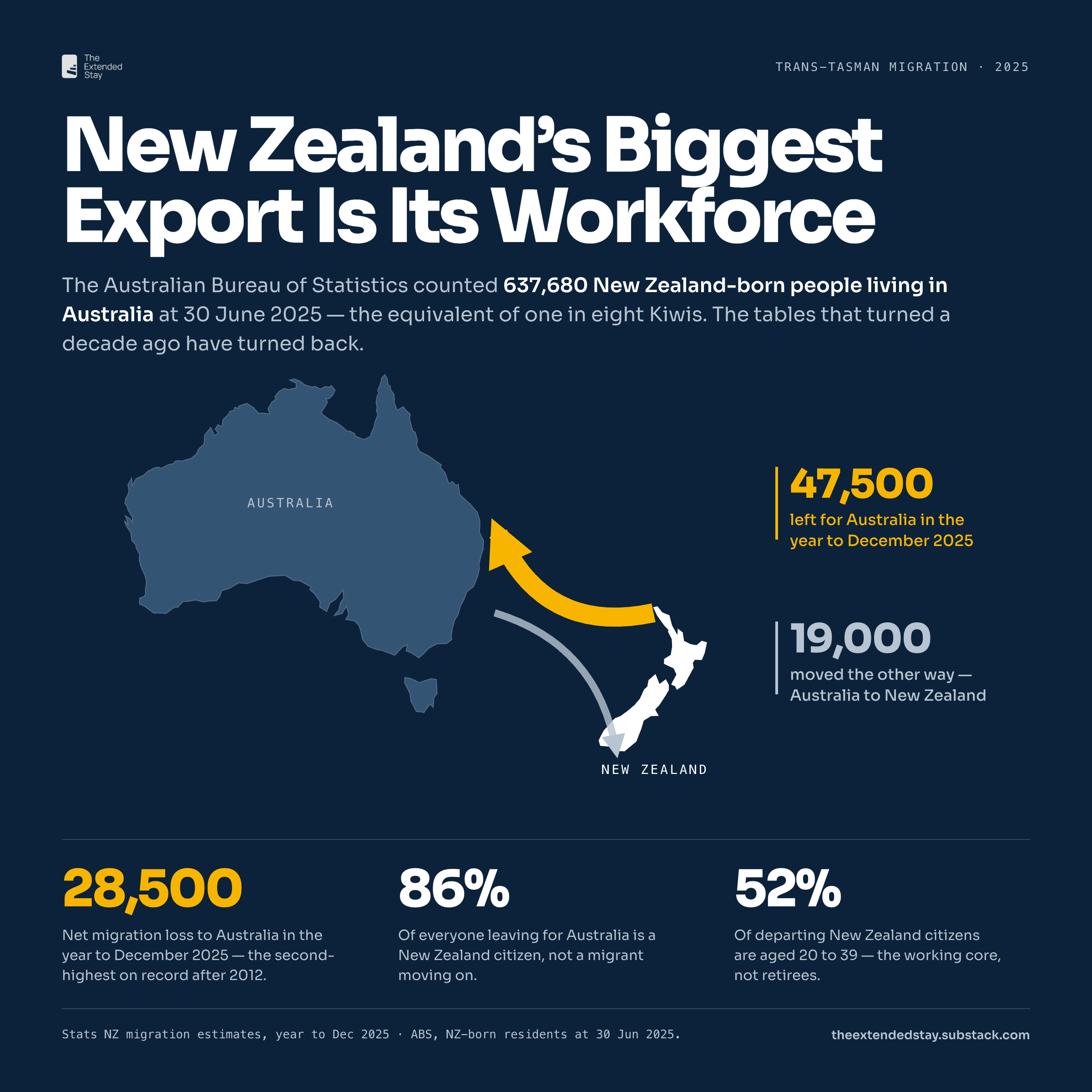
In the same twelve months that the story kept circulating, 62,800 New Zealand citizens left the country to live abroad, with most of them choosing Australia as their new home.
Those two facts describe the same problem from opposite ends. New Zealand has never had trouble being recognized and admired. Lately, though, it has developed a difficulty keeping people who already chose to live there.
What caused that?
A brand that outperforms the economy
Tourism is not a soft sector in New Zealand.
In the year to March 2025, according to the Tourism Satellite Account.
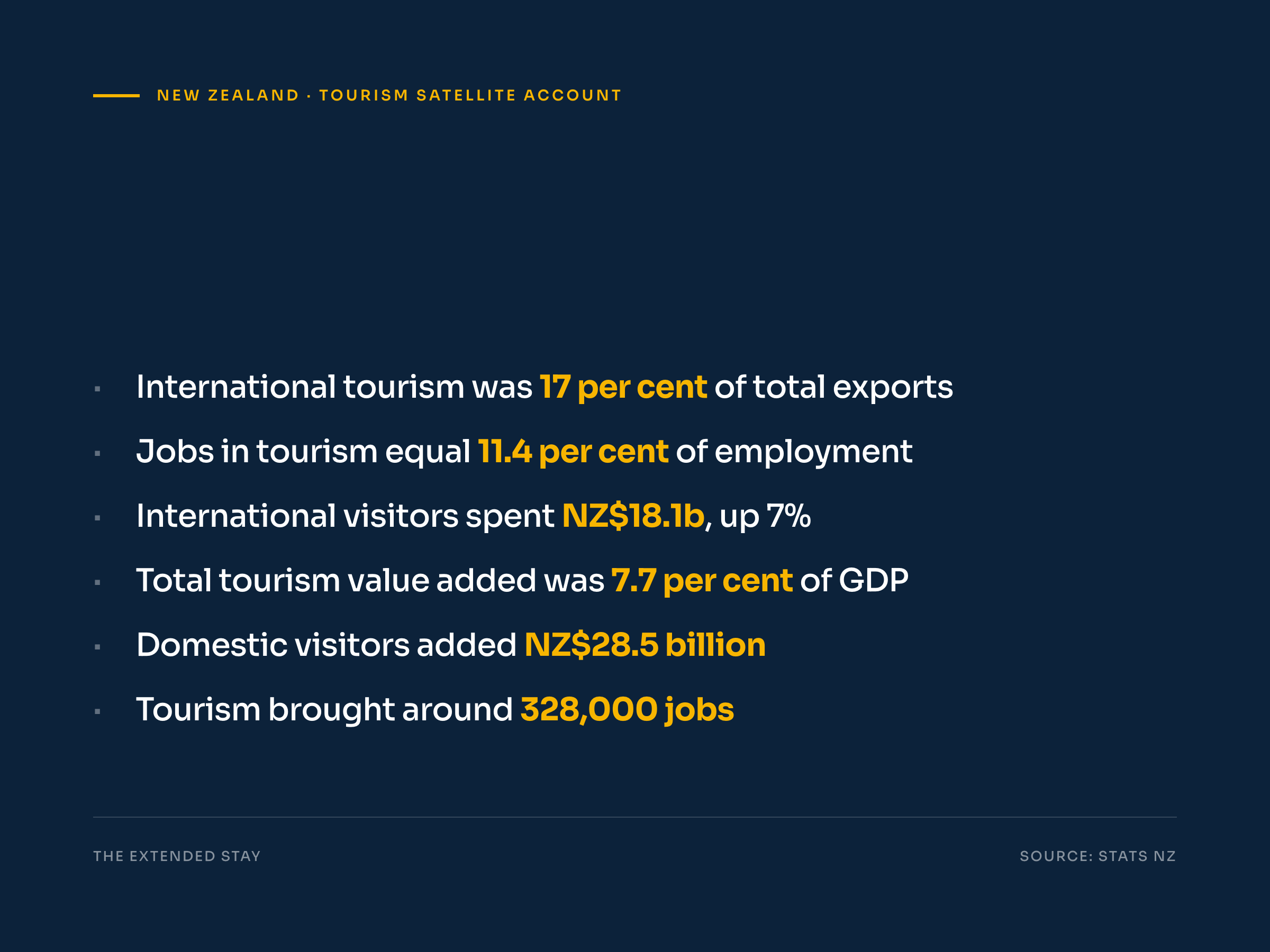
Direct tourism employment is 195,000 people and almost 7% of everyone employed in New Zealand.
That performance rests on a brand advantage most destinations can only dream of having and would pay heavily to manufacture.
Safety, political stability, English language, incredible landscape, and two decades of free global marketing courtesy of Peter Jackson and his Lord of the Rings and The Hobbit movies.
That performance rests on a brand advantage most destinations can only dream of having and would pay heavily to manufacture. Safety, political stability, English language, landscape, and two decades of free global marketing courtesy of Peter Jackson's The Lord of the Rings and The Hobbit movies.
Distance used to be the qualifier on all of it. New Zealand was always seen as lovely, but it was “pretty far away” from most other places in the world. That added to the travel appeal, and curbed the relocation demand.
The pandemic and the decade of geopolitical noise that followed changed how some people think about that distance. Remoteness is now perceived as an insulation rather than isolation. That shift is still largely anecdotal and heavily skewed towards a handful of very wealthy individuals whose plans, as Wanaka demonstrated, do not always survive contact with a district council. But beyond the wealthiest, the pandemic has also created a new pool of extremely lean, mobile, location-flexible workers, and New Zealand ranks highly on that group’s list.
New Zealand’s real challenge is not population growth. It is productive retention
Here is the part that gets lost when the story is told as a brain drain.
New Zealand’s population is still growing. In the June 2026 year, the country recorded a net migration gain of 17,625. Arrivals rose 1 per cent. Departures fell 5 per cent. On the headline number, the trend is improving.
Underneath it, the composition is doing something else. In that same year:
63,901 New Zealand citizens departed long-term
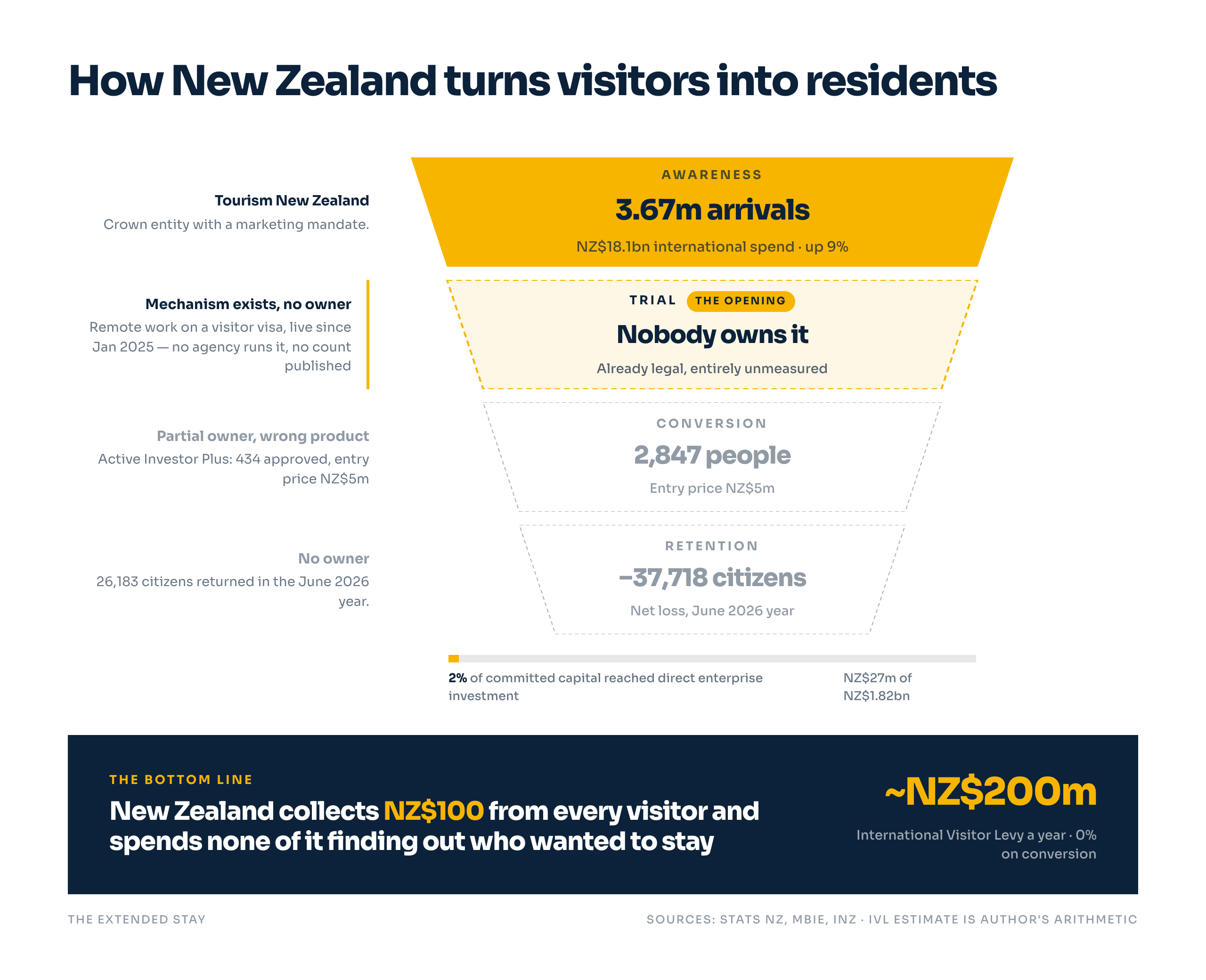
26,183 New Zealand citizens returned
Net loss of New Zealand citizens: 37,718
Net gain of non-New Zealand citizens: 55,341
New Zealand gained people, and New Zealand lost New Zealanders.
The latter statement is masked by the former, which is exactly why the headline number is a poor guide to what is happening to the country’s productive base.
Why citizen departure is economically different from migration churn
Generic migration churn is largely replaceable at the level of headcount. Citizen departure - not so much.
First, selection. In the March 2025 year, 27,200 of the 70,000 departing New Zealand citizens were aged 18 to 30, 39%of the total. Two out of every five departing citizens are in the window where people acquire their first serious skills, build professional networks, and decide where to spend the next forty years.
Second, sunk public cost. Those people were educated at New Zealand’s expense and begin paying it back somewhere else. The fiscal profile of an emigrating 26-year-old is close to the worst case: full cost incurred, contribution deferred indefinitely.
Third, the exit is frictionless and the return is optional. Trans-Tasman mobility rights mean a New Zealander in Melbourne is not an expat facing visa expiry. They are a resident with an indefinite right to stay. Nothing forces the decision back onto the table.
Fourth, replacement is not substitution. The 55,341 non-citizens who arrived net are not distributed like the people who left, by skill, by sector, by region, or by lifecycle stage. Migration can hold headcount steady while the underlying mix of skills, tenure and location shifts in ways nobody planned.
Is any of this deliberate? New Zealand has never adopted a formal population target, and it does not have a population strategy to trade off against. In April 2026, Koi Tū, the Centre for Informed Futures, published People, place and prosperity: The case for a population strategy, arguing that New Zealand needs a long-term, non-partisan population strategy spanning workforce, infrastructure, public services and regional growth. In May 2026, demographers at the University of Waikato put it more bluntly in The Conversation: New Zealand "has yet to develop anything resembling a coherent population strategy," despite decades of expert recommendation.
New Zealand is not Japan. The demographic profile is younger, the migration settings are more open, and the policy posture is not one of managed decline. But it faces a recognisable advanced-economy version of the same problem: ageing, weak natural increase, direct competition for talent with larger English-speaking economies and a growth concentrating where pressure is already highest.
And this is where the tourism success story stops helping. Tourism is a business designed to end. Every metric that matters to a destination marketing organisation -
length of stay
satisfaction
arrivals
spend
- is measured on the assumption that the visitor leaves.
A retention strategy is a different product with different economics, different timeframes, different risks and a different definition of success.
Being brilliant at the first tells you almost nothing about whether you can do the second, and New Zealand’s numbers show precisely that split: world-class at attracting attention, structurally weak at converting it.
New Zealand needs more people. It is that New Zealand needs a far more intentional strategy for retaining and converting the specific people most likely to strengthen places, businesses, local capability and long-term resilience.
The number that actually matters
So back to the citizens.
Australia has become the most common destination, taking roughly 56 % of departing New Zealand citizens in 2024. It is not a mystery why. Trans-Tasman mobility rights, a shared language, higher wages in trades, mining, healthcare and construction, and cities where the wage-to-housing ratio compares favourably to Auckland.
Given that New Zealand looks close to perfect on paper, why are young professionals leaving it?
Lifestyle quality and career opportunity are different products. New Zealand sells the first at world-class level. It appears to have lost the second to a neighbouring country.
Three levers the country is pulling right now
More eyes have been on the New Zealand case in the past few months. Not because of a single reform, but because three different constraints are being addressed in parallel.
1) Housing supply
Auckland is the closest thing anyone has to a controlled experiment. The city grew from roughly 1.4 million people in 2010 to about 1.8 million in 2025, and over the same decade it rezoned around three-quarters of its residential land, letting single-storey houses on lawns be replaced by taller, narrower terraced townhouses.
Auckland’s housing stock is now over 600,000 units, which is 101,000 more than a decade ago. That equates to a 19.5% rise according to a 2025 policy paper by Greenaway-McGrevy, James Allan Jones and Chris Crow. Their peer-reviewed research argues the upzoning increased construction and moderated rents relative to what would otherwise have happened.
Nicole Bennetts, head of policy at the Planning Institute of Australia, told the Financial Times that “urban economists [around the world] have analysed the outcomes and found it successful in increasing the number of homes.”
The counter-case also has a name. Tim Helm, an independent economist, calls the causal story the “myth” of the Auckland Unitary Plan. “It is far from clear that the post-2016 building boom was caused by the policy itself,” he told the FT.
Either way, the building happened. Auckland is still less dense than most large global cities, and the plan’s expansion is projected to lift potential new dwellings from 1.2 million to between 1.4 and 1.6 million.
Many places around the world are inviting immigrants but forget to build the basics. Having housing available to current and aspiring residents is the first condition for any place that wants to attract people, and it is the reason Auckland belongs in this article at all. Attraction without absorption is how a destination manufactures its own backlash.
2) Foreign Direct Investment
The Active Investor Plus visa was restructured from 1 April 2025 into two categories:
Growth, at NZ$5 million held for three years in higher-risk assets
Balanced, at NZ$10 million over five years.
Nicola Willis, Economic Growth Minister, framed it plainly when the changes were announced: “Rather than turning potential investors away, this Government is intent on welcoming people who want to contribute to New Zealand.”
As at 16 August 2026, Immigration New Zealand had received 872 applications covering 2,847 people, approved 434, and recorded roughly NZ$4.8 billion either committed or in the pipeline.
But when looking into it, the “economic contribution” gets broken down into a more sober statement.
80 % of Growth category capital, some NZ$1.2 billion, went into managed funds,
83 % of Balanced category capital went into bonds.
Direct investment in Growth category enterprises: NZ$27 million. That equals 2%.
The policy is doing an excellent job of attracting capital to New Zealand and a poor job of attracting capital deployment into New Zealand enterprise.
The property carve-out sharpens the risk. Legislation currently lets investor visa holders buy residential or lifestyle land above NZ$5 million.
The government’s own framing is that this touches well under 1 per cent of New Zealand houses, which is probably accurate. It also tells prospective applicants that residency here can come bundled with a trophy asset, which is precisely the incentive that unfortunately turns an investor programme into a wealth-parking programme.
3 ) Remote work and mobile workforce focus
Since January 2025, visitor visa holders have been permitted to work remotely for employers or clients outside New Zealand, with no cap on the amount of such work while the permission is valid.
The prohibitions are clear:
No exchange of services with New Zealand businesses
Nothing requiring physical presence
No New Zealand employer
Tax residency is the real constraint, with thresholds at 92 days and, for residents of treaty countries, 183 days.
Immigration New Zealand does not call this a remote work visa. It is a permission attached to visitor status. It does not lead anywhere on its own.
The intent is sound. The Working Holiday visa has funnelled young foreigners into New Zealand for decades, and with the workforce more mobile than ever, the government has correctly identified an opportunity to attract higher-contributing travellers who bring spending into local economies during shoulder season, and who get to test what living in New Zealand actually feels like. Louise Upston made the spending case explicitly when the change was announced.
The extended stays also serve as a bridge between tourism and retention.
The problem is that testing what living in New Zealand feels like is only valuable if there is something to do with the answer.
What we would build
We are not going to pretend a newsletter solves a national productivity problem, but we spend our working lives on the mechanics of long stays, and the mechanics are where this is breaking.
5 moves, none of which require inventing a new category of arrival.
1)Build a long-stay pathway that leads somewhere: the January 2025 remote-work permission can create a cohort of high-income, self-funding people who have already spent months in the country on their own money, and that stay history currently expires unused, so let them apply into an existing skilled or entrepreneur category with sustained income and tax compliance.
2) Put an additionality test on investor capital: weight the thresholds so that direct investment into operating businesses, regional projects, export capacity clears at a materially lower dollar figure than passive holdings.
3) Run two-year long-stay pilots with regions that opt in and can show housing headroom, service capacity and a genuine local mandate, with exit triggers if pressure indicators move the wrong way, because eighteen territorial authorities are shrinking while growth concentrates where the strain already sits, and a hundred long-stay professionals spread through shoulder season do more for a small local economy than ten thousand additional day visitors to the same three destinations.
4) Instrument the conversion funnel rather than the arrivals count: visitor, repeat visitor, extended stayer, resident, founder or employer or investor, community participant, measuring drop-off at every stage, owned by one named person with a budget rather than a cross-portfolio working group. Know the difference between knowing your traffic and knowing your conversion rate.
5) Treat New Zealanders abroad as a network instead of a loss column: what is missing is the commercial layer, employer matching, recognition of overseas experience, relocation support into regions with real capacity, and a clear route for someone who wants to bring a business or a client base rather than take a job. They already have the right to be here and need no assessment, which makes them the cheapest conversion on this list.
Where the levers come short
Look at this through a relocation funnel and the shape of the gap is obvious.
New Zealand runs one of the most effective top-of-funnel operations in global destination marketing. Millions of visitors every year are supported by extraordinary brand recall and a self-selecting audience that skews towards people with money and mobility.
What the country does not have is a designed path from that visit to residency.
A visitor who stays three weeks forms an impression.
A visitor who stays four months working remotely forms a life.
That person is a qualified lead in a way no campaign can manufacture, and at the end of their stay, New Zealand currently hands them nothing but a departure card.
Nothing connects the remote-work permission to a skilled residence pathway.
Nothing connects investor arrivals to founders who might hire.
Nothing connects a repeat visitor with a business idea to the region that would most benefit from it.
Tourism, immigration and economic development run as separate portfolios with separate metrics, which is the norm almost everywhere and is exactly why doing it differently would be an advantage.
The 3-levers policy has not yet delivered the desired outcomes, and the reforms carry obvious failure modes.
Building completions and consents are not affordability.
Investor capital sitting in bonds and funds does not create high-wage jobs.
Remote workers spend money but do not fill vacancies in health or construction, and their tax contribution is deliberately limited.
New Zealand’s problem was never desirability. Admiration is free, and relocation is expensive, and for two decades the country has been exporting the people best placed to close that gap.
The reforms now in play are the first serious attempt to make staying the rational choice.
Miloš