Which European Cities Can Legally Ban Airbnbs Now?
Miloš Pelucha · Thu Sep 10 2026

In today’s edition of The Extended Stay:
Why are short-term rental properties considered an ongoing problem in Europe?
What did the “STR limiting law” achieve in cities like NYC?
What impact do tourism strategies, visa programs, and housing development have on the STR industry?
Which European cities will likely be able to ban STR licensing overnight?
Soon, European cities will be allowed to restrict short-term rentals once their home prices reach around eight times median disposable income, according to a draft of the EU Affordable Housing Act obtained by Euractiv and not yet published as a Commission text.
It’s an interesting filter given that the data has been public for years.
If you look into it:
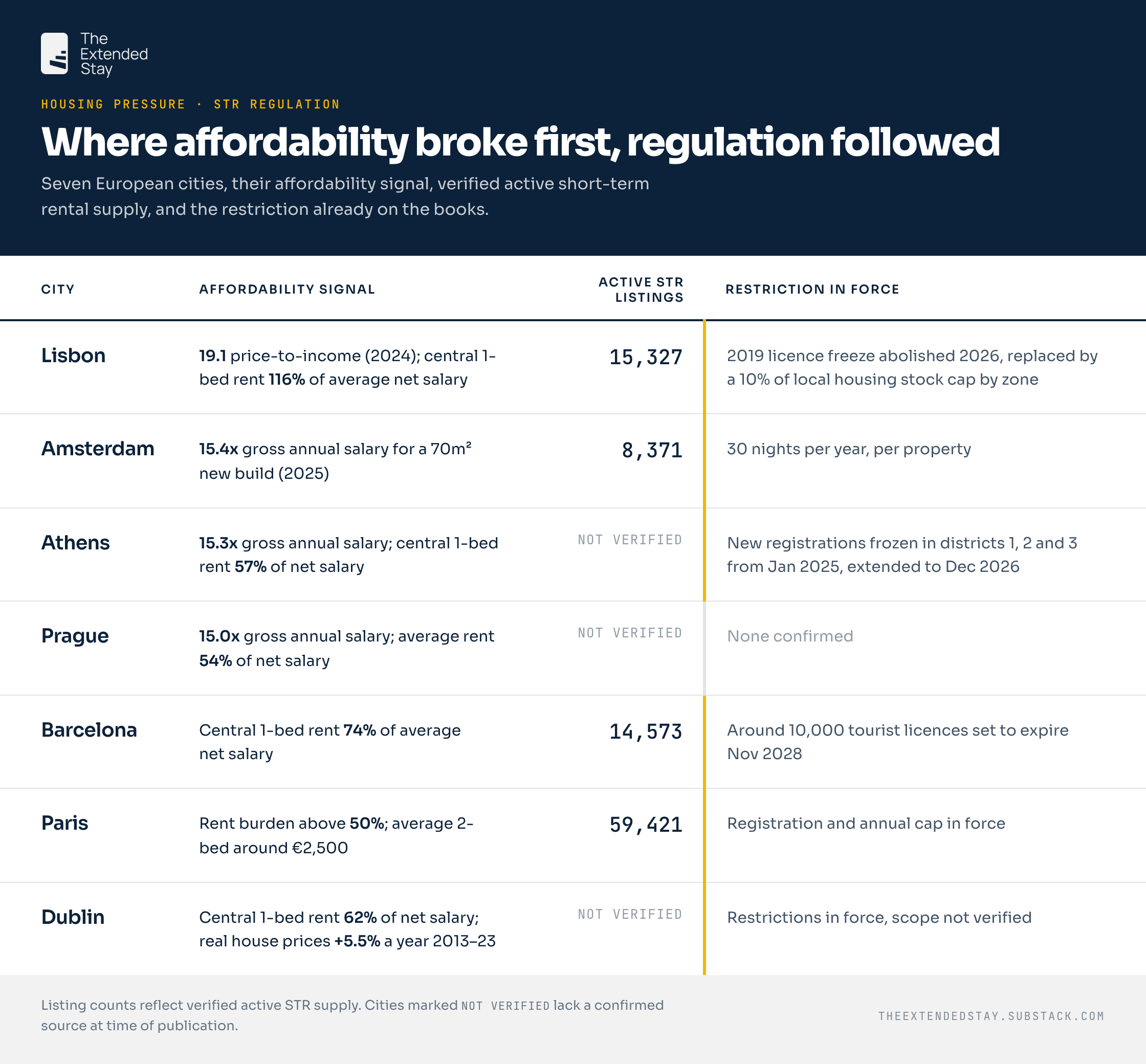
Lisbon's current home price to median disposable income is at 19.1 x
Amsterdam at 15.4 x
Athens at 15.3 x
Prague at 15.0. x
While nobody in Brussels is naming the cities, this act is being approved; the threshold and available data do it for them anyway.
Here is the list of some of the cities that have been dealing with significant housing crises in the past years, their affordability signals, active STR listings, and possible restrictions in force.
What is this act supposed to do?
It’s important to highlight that this act effectively bans nothing. It just gives national and local authorities a defensible legal basis to restrict short-term rentals in areas they can prove are under housing stress, and it sets the evidence bar: price-to-income ratios and their trend, population and supply dynamics, and demonstrated adverse impact sustained over three or more years.
The draft favours quantitative caps and grandfathering over outright bans, and requires any measure to be proportionate, non-discriminatory and in the public interest.
If you have been following the growing disinterest towards the STRs in Europe, you know that cities already had the political will. What they lacked was protection against legal challenge, which is what Barcelona spent two years fighting before Spain’s top court backed its phase-out. The new EU act provides the protection needed.
Short-term rental bookings in the EU have nearly doubled since 2018.
EU home prices are up more than 60% since 2013.
But despite what you often read in the mainstream media, short-term rentals stand for only about 1.2% of EU housing stock. This is the figure global OTAs like Airbnb, Booking.com and Expedia have been building their objection around for a while.
Surely 1.2% of supply cannot cause a 60% price rise. Or can it?
Nonetheless, this argument becomes irrelevant now.
So, what happened to a place that already successfully and legally banned short-term rentals before?
New York City tried this experiment; the results will (not) surprise you
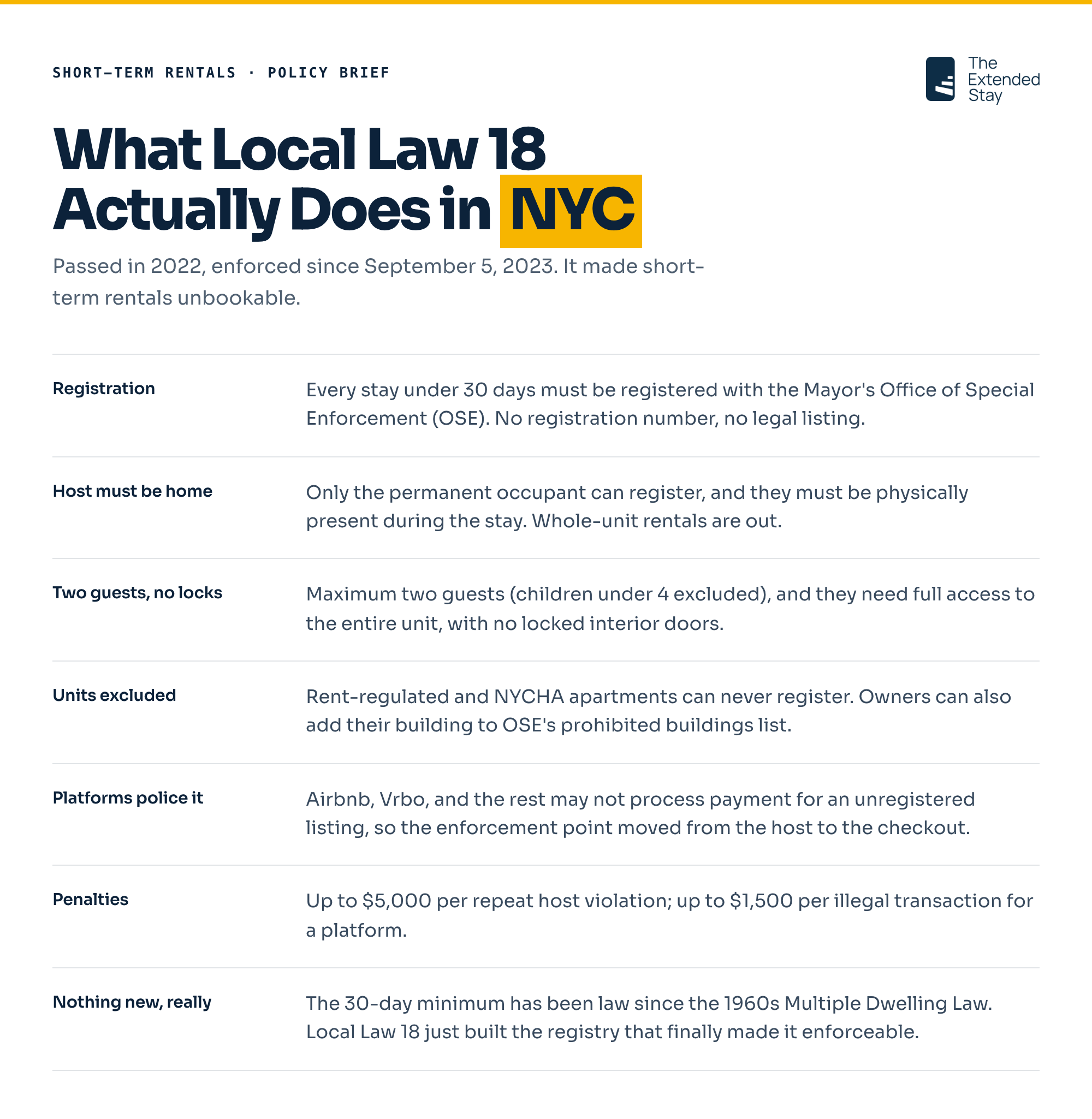
Local Law 18 in NYC is the closest thing to what Europe is attempting to set up with their newest act.
Enforcement of Local Law 18 began in September 2023.
The listings on the OTAs fell from around 13,000 to about 1,600. On paper, one of the objectives of this law was to tackle housing affordability. So what were the results achieved?
As some may expect, this law had no impact on housing prices.
Between August 2023 and May 2026, the ten neighbourhoods with the densest Airbnb concentration saw rents grow over 10%. The citywide median grew 11.1%.
The areas that lost the most short-term rentals got cheaper relative to the rest of the city by a rounding error. Midtown, which lost 776 listings, saw rents grow 14.6%.
Meanwhile, hotel rates hit the most expensive levels on record, about $290 million in annual host revenue left the city, and short-term rental activity in Jersey City and Newark rose 241%, capturing around $45 million a year of it. Lower-income neighbourhoods lost the most income relative to what residents actually earn. The units and the spending did not vanish: they both crossed a boundary.

Every one of these rules is a night count, which makes it a product spec
Of the New York City listings affected by the law, 44% left OTAs entirely, 42% converted to 30-night minimums, 7% switched to private rooms, and 7% carried on operating short-term.
The largest surviving cohort stayed in the market and changed its minimum stay.
How some cities in Europe write STR rules:
🇳🇱 Amsterdam permits 30 nights a year.
🇬🇷 Greece classifies anything under 60 days as short-term and requires registration.
🇺🇸 New York’s line is at 30 nights.
In nearly every regime, the instrument is a threshold expressed in nights.
Below the line, the law treats you as tourism. Above it, you are housing. The specification is the extended stay, at 28, 30, or 60 nights depending on the jurisdiction.
There is a fair objection here, which is that NYC’s hosts converted under emergency conditions with no warning, and that three years of notice might produce orderly exits and asset sales instead.
That is possible. It is also the opposite of how the same owners behaved when they had no time to plan, and the assets in question are apartments in supply-constrained cities that hold value in either use.
If you’re thinking of investing in a short-term rental property, think of the market first. Policy risk will continue increasing.
What impact do Immigration and Visa policy bring?
The obvious objection is that these governments are incoherent.
They restrict short-term rentals to protect housing while running investment migration and nomad visa programmes that import competition for the same housing.
Spain closed its golden visa in April 2025 citing the housing crisis while running Europe’s most aggressive short-term rental phase-out. Portugal shut the real estate route in October 2023 and expanded its digital nomad visa. Greece raised its prime-zone threshold to €800,000 while freezing new short-term rental registrations in central Athens.
There is no problem with high-skilled immigration. Quite the opposite.
But what we are seeing is governments using immigration policy to attract affluent segments with higher disposable income than the local population.
So, if paired with a lack of new property development, what will the outcome be?
You guessed it right: growing housing prices.
The possible counter-evidence
The strongest argument against all of this came from Lisbon this year.
Lisbon abolished the blanket freeze on new short-term rental licences it imposed in 2019, replacing it with a framework allowing short-term rentals up to 10% of local housing stock in designated zones. The stated reason was that the freeze did not work.
During it, annual rent increases in the Lisbon metropolitan area accelerated from 5.7% to 9.2%, residential sale price growth nearly doubled, and hotel prices rose around 30% between 2022 and 2024.
Sara Rodríguez, Head of Public Policy for Spain and Portugal at Airbnb, said strict “rules on short-term rentals failed to make housing more affordable, and that supply shortages rather than short-term rentals drive affordability crises.”
Rodríguez works for the company with the most to lose, but there is growing evidence that “restrictions failed,” with evidence circulating for Lisbon, Barcelona, Amsterdam, and Edinburgh. Together with New York City’s case, the regulations on STRs on either side of the Atlantic don’t seem to bring any benefits to struggling housing markets.
I think the crackdown will not fix housing and will happen anyway. But we know that the animosity towards the STRs has become a political issue at this point. And Capping is always cheaper and easier than building.
What does this change bring for investors and destinations?
If you own a house in a city on that list, you hold an asset whose legal minimum stay will be reset by someone else, on a timeline you do not control, in a direction you can already read.
The NYC conversion rate is the number to plan with. 42% of affected hosts moved to 30-night minimums rather than exiting, under emergency conditions, with no product built for it. Europe is at least giving three or more years of notice, which is enough time to build the product properly rather than improvise it.
Interested in learning more about mid-term rental? Read this and learn about 4 ways to structure it.
Interestingly though, for destinations, the warning is sharper. Capping short-term rentals without building mid-term supply is what New York did, and New York got record hotel rates and no rent relief, plus $45 million a year of visitor spend relocated across a river. If your city has no Jersey City next door, that spend goes to your hotels or it goes to the next destination.
The apartments stay where they are. What changes is the number in the minimum-stay field.
Miloš
Want to read more on the topic? Read why a coliving product in the U.S. doesn’t work.