Asia Isn't Hosting Nomads. It's Recruiting Them.
John Ho · Thu Jul 09 2026
Almost every conversation I have at Alt_ these days starts the same way. Someone’s fed up with home. The rent, the politics, the sense that the grind doesn’t add up to much anymore. And they’re not asking about a two-week trip. They’re asking how long they can stay.
Chiang Mai comes up. So do Bali, Fukuoka, Busan, Tokyo, Jakarta, Singapore. Not as places to visit, but as places to base. These are people with portable income and no real reason to sit in San Francisco, London or Berlin paying triple for less. They’re testing whether a life somewhere else is possible.
But the shift that matters isn’t that they’re coming. It’s what they’re asking for. How to register a company. How to hire locals. Whether they can buy a car, and how long a lease they can sign. They’ve stopped behaving like visitors and started behaving like movers. And the countries they’re eyeing have built exactly the machinery to catch them.
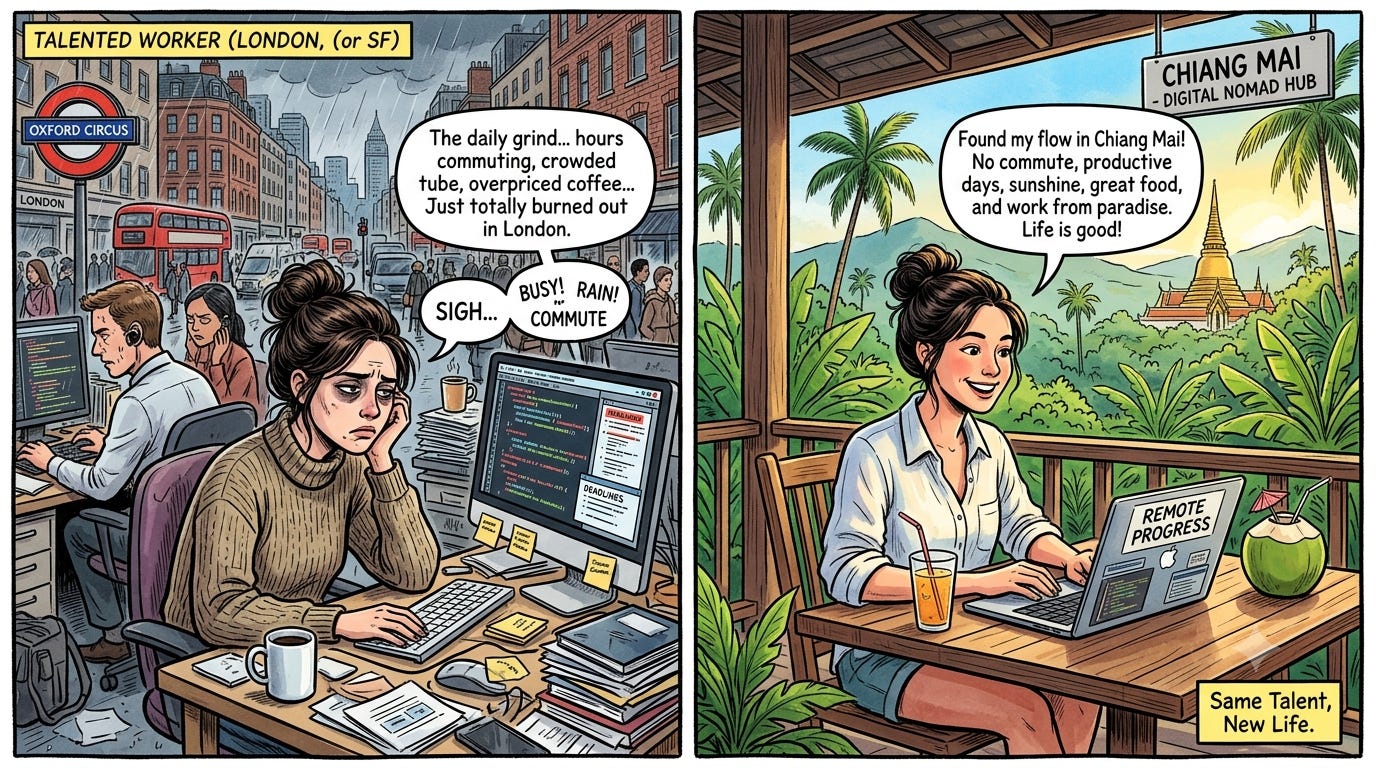
The visitor profile flipped
I don’t have a survey, but I have a coliving space and a lot of tea-break and coffee conversations. But the pattern is consistent enough. The people showing up aren’t fleeing for a season. They’re auditioning cities.
A few years ago the question was where’s cheap and fun. Now it’s where can I actually build something. That’s a different guest. They want reliable internet, job opportunities, business opportunities, a bank account, a lease longer than a month. They’re behaving like residents before anyone’s offered them residency.
If you operate a property, that shift is the whole story. Demand is moving from short and transactional to long and rooted. The person who wants six months is a different customer than the person who wants six nights, and most operators are still built for the second one.
The nomad visa is a front door, not a destination
Here’s what most people miss about the visa wave. The nomad visa isn’t the offer. It’s the hook. What sits behind it is a funnel that quietly points toward staying for good.
Thailand shows the whole ladder. The DTV gets you in the door. Above it sits a 10-year Long-Term Resident visa aimed at skilled professionals and investors, with the government saying plainly it wants a million wealthy or skilled foreigners inside five years. And for the high-net-worth crowd who’d rather just pay, there’s the Privilege visa, the old Elite program, where 650,000 to 5 million baht buys 5 to 20 years and nobody asks about your income. Different doors, same building. Taiwan runs a similar move, dangling its Employment Gold Card and a real shot at permanent residence for nomads who stick around.

And it isn’t just the capitals. Two weeks ago I was in Kuching meeting the team at SDEC, Sarawak’s state digital economy corporation. They’d just opened the DE Rantau Sarawak Nomad Pass, up to two years for remote workers, and they were open about wanting to make Sarawak a nomad hub for ASEAN. Read the eligibility and the target is obvious. The pass is written for tech and digital talent, software, cloud, cybersecurity, AI, machine learning, the exact skills a young digital economy can’t grow fast enough on its own.
That’s the part worth saying out loud. Asia isn’t chasing tourists. It’s chasing the West’s high-skill leak, tech people especially, and plugging them into gaps its own workforce can’t fill yet.
That’s the tell. You don’t build a two-year pass for AI engineers, or a decade-long residency track, for tourists. You build it for the movers, the exact profile now turning up in my common room asking how to register a company and hire locals. These countries aren’t hosting nomads. They’re recruiting them, and the visa is just the first step of the pitch.
Why four shrinking countries want you to move in
The reason is demographic, and it’s brutal. Taiwan’s fertility rate fell to 0.695 in 2024, the lowest in the world. South Korea sits at 0.75. Thailand’s is around 1.0, and its population is already shrinking. These are not countries with a spare generation coming.
So the long-stay visas read less like tourism policy and more like slow-motion recruitment. Thailand launched the Destination Thailand Visa in mid-2024. Taiwan opened its digital nomad visa in January 2025. Korea rolled out a workcation visa. Japan added a six-month remote-work visa in 2024. Four countries facing population decline, all opening the same kind of door inside two years.
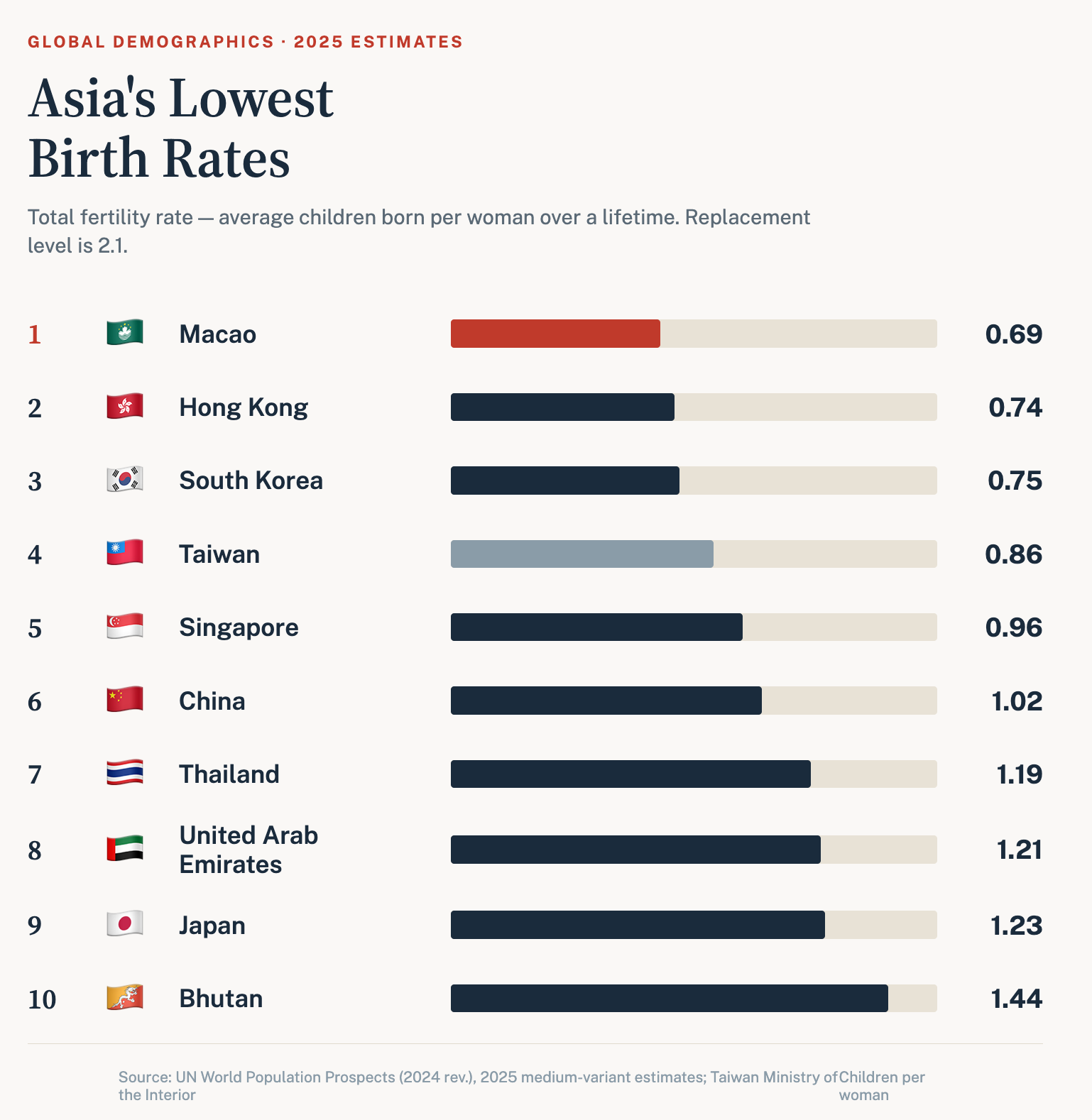
I can’t prove intent. But when the demographics and the visa launches line up this tightly, I’d rather assume it’s a strategy than a fluke.
Same problem, four different games
What’s interesting is how differently each country plays it. Thailand does the most natural version. It has absorbed foreigners for decades through intermarriage, retirement visas, and a general ease about outsiders settling in. You can see it in the schools. In Chiang Mai alone, by my count, international schools have gone from around 15 to nearly 20 in five years. Those aren’t built for tourists. They’re built for families who plan to stay.
Japan is the one in real dilemma, and it’s worth watching precisely because it’s conflicted. One camp inside the country understands that foreigners are the fastest way to slow a population in free-fall. The other camp wants to protect national identity at almost any cost. Both are winning at once. Foreign workers hit a record 2.57 million in 2025, led by Vietnamese, Chinese, and Filipinos, while an openly anti-foreigner party gained seats in the July 2025 election. The country is opening the door and arguing about it on the way.
Taiwan and Korea are a different flavor again. This part is just my opinion: When your fertility rate is the lowest on earth and a larger neighbor is waiting for you to weaken, people become a security question, not just an economic one. Every foreigner who builds a life there is one more reason the place holds together.
The DTV is a five-year door. Who captures what walks through it?
Thailand’s Destination Thailand Visa is the offer I keep coming back to, because the math is unusually good. 180 days per entry, extendable to roughly 360, valid for five years. Over 35,000 people had applied by July 2025. That’s not a tourist visa with extra steps. That’s a framework for building a life without committing to one.
Which raises the question I don’t have a clean answer to yet: When thousands of earners settle into a city for years at a time, who captures the value? Right now a lot of it just passes through. They pay rent, buy coffee, and leave the deeper economics somewhere else.
I can see two channels worth building around. The first is companies that want to hire this talent locally instead of importing it or losing it. The second is a government that treats these long-stayers as a new tax base rather than a rotating set of guests. Both turn a visitor into a contributor. Neither happens on its own.
Thailand is already reaching for that second one. Since 2024, anyone who counts as a tax resident, meaning 180 days or more in the country, owes Thai tax on foreign income they bring into a Thai bank account. That’s the government quietly turning long-stayers into taxpayers. The same 180-day threshold that defines a DTV entry also defines a tax resident, which tells you the two systems are looking at the same person.
For an operator or an investor, that’s where the opportunity sits. The popular bases, Chiang Mai, Bali, Fukuoka, Busan, are worth a hard look for the businesses that sit next to the housing. Not just the beds, but the services a semi-resident needs once they stop being a tourist.
Remote work isn’t dying. It’s changing shape
There’s a mainstream narative that the remote-work era is winding down, that the return-to-office memos won. From where I sit it looks like the opposite. AI is making individuals more productive at the same time companies are trimming headcount. Put those together and you get more people, not fewer, who can earn from anywhere.
Look at what AI actually changed. A skilled person can now run the kind of operation that used to need a small team. One founder plus a stack of AI tools handles the code, the design, the marketing, the admin. That means more people can generate real income without a corporate job anchoring them to a city. Downsizing pushes people out of the office. AI hands them the tools to work for themselves. Both point the same direction, toward more one-person businesses that can run from anywhere with decent wifi.
Those are exactly the people auditioning cities over coffee at Alt_. The pool of high-value foreigners who can geo-arbitrage is getting larger, and it’s getting there faster than the last cycle did. The countries that just opened their doors are, whether they planned it this precisely or not, standing in the right spot at the right moment.
The tide is coming in. The question is who builds the harbor
None of this is guaranteed to go well. The same inflow that lifts a city can price locals out of it, and plenty of talent-heavy places learned that the hard way. But the flow itself looks real, and it’s pointing east. The movers are coming, the shrinking countries need them, and the funnels are already open.
If you’re deciding where to plant something, watch which governments campaign for these people and which just permit them. The cities running actual campaigns, stacking reasons to stay longer, are the ones telling you where this is heading. Those are the harbors worth building next to.
For those of us operating in these cities, that’s not a threat. It’s a window. The operators and investors who figure out how to capture value from long-stayers, rather than just house them for a while, are the ones who’ll still be standing when the policy tailwind fades. The rest of us will have watched a lot of good customers pass through on their way to somewhere that was paying attention.
If you’re investing in this space, I’d genuinely like to know where you’d put money first. Which of these bases do you think turns visitors into contributors, and which just rents them a room?
John Ho runs Alt_ChiangMai & Alt_PingRiver, two coliving and coworking spaces in Chiang Mai, and leads the Nomad Friendly District initiative. The Extended Stay covers emerging trends in community-powered hospitality for operators and ecosystem builders.